Securing your own clinical sites and preceptors at IWU
Indiana Wesleyan places the preceptor search with the student. Program faculty work alongside you and the university approves what you bring, but each course asks for a different kind of site. Below, the rule is broken down for FNP, PMHNP, leadership, education and doctoral students.
Get your placement plan
Tell us your IWU program and where you live. A placement advisor replies with the preceptor and site options that fit your IWU course.
What the rule says and what it leaves to you
The sentence students quote most comes from IWU's post-graduate FNP certificate FAQ: "Students are responsible for securing clinical sites and preceptors." A second answer on that page fills in the division of labor. You identify potential preceptors and sites, program faculty work with you on securing them, you submit documentation for review, and the university vets and approves each site and preceptor.
The MSN/MBA page says the same in its own words: students identify and secure their clinical sites, and the School of Nursing approves them. So the work that falls to you is finding a clinician, getting a yes, and getting the paperwork in on time. IWU's part is the review and the approval.
Students report the same experience in outside reviews. On one third-party program review site, students describe finding clinicals as entirely their own job, and one mentions receiving preceptor suggestions but still arranging everything, travel included.
FNP courses: five clinicals with a primary care focus
The FNP sequence runs in lock-step, one course at a time, and each clinical course needs supervised clinical experience. Per-course hours are not published; the 2026-27 catalog gives only the program total of 850 supervised hours and a floor of 800 patient encounters.
| Course | Clinical focus | Per-course hours |
|---|---|---|
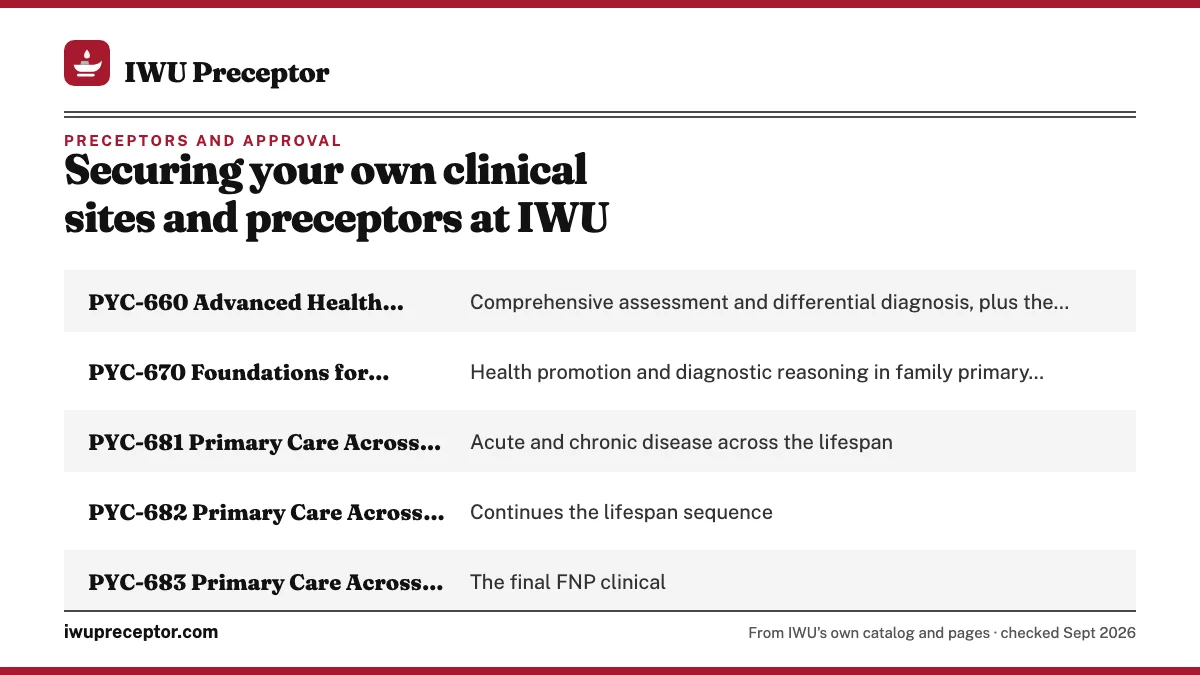
PYC-660 Advanced Health Assessment | Comprehensive assessment and differential diagnosis, plus the onsite residency | Not published |
PYC-670 Foundations for Primary Care Practice | Health promotion and diagnostic reasoning in family primary care | Not published |
PYC-681 Primary Care Across the Lifespan I | Acute and chronic disease across the lifespan | Not published |
PYC-682 Primary Care Across the Lifespan II | Continues the lifespan sequence | Not published |
PYC-683 Primary Care Across the Lifespan III | The final FNP clinical | Not published |
IWU steers FNP rotations toward primary care and outpatient settings across the lifespan: pediatrics, internal medicine, family practice and women's health. Some specialty hours may be allowed, but most must be in primary care. The encounter minimums (350 adult, 40 of them women's health, and 150 pediatric) mean your site mix matters as much as the hours. The patient encounters page shows how to plan for each count.
PMHNP courses: hours set course by course
The PMHNP track is easier to plan by the numbers because IWU's course pages list hours for each clinical course. The trickier part is fit: each course centers on a different kind of psychiatric work.
| Course | Hours | Focus |
|---|---|---|
PMHN-652 | 75 | Lifespan assessment centered on psychiatric symptom sets |
PMHN-628 | 150 | Interviewing, documentation and therapeutic communication |
PMHN-630 | 175 | Psychotherapeutic work with individual patients |
PMHN-640 | 175 | Family and group therapy in a variety of settings |
PMHN-650 | 175 | Diverse clients with multiple conditions |
PMHN-693 | 35 + onsite intensive | Interprofessional simulation |
Those course figures add up to 785, while the catalog sets the program at 820 and IWU's web page says 525. Follow your syllabus. Because PMHN-640 centers on family and group therapy, ask early whether a preceptor's practice includes those modalities. Our PMHNP clinical courses page goes course by course.
Leadership, education and RN-to-BSN practicums
Non-NP tracks still need sites, just of a different kind. The MSN in Health Systems Leadership, its ASN-to-MSN and Post-MBA versions and the MSN/MBA carry 520 practicum hours across GNUR-529P, GNUR-532P and HSL-680P through HSL-688P. The capstone practicum happens at a location you choose, and Post-MBA students need the practicum agency's go-ahead before logging a single hour. The HSL certificate's roughly 260 hours usually happen at your workplace or another approved setting.
Nursing Education students complete NRE-664 (35 hours in a clinical nursing practice area, with a master's-prepared preceptor) and NRE-695 (140 hours in supervised educational settings). RN-to-BSN students build toward the NUR-492 immersive practicum and its quality-improvement project, which IWU notes is often done at the student's own workplace. See using your workplace as a clinical site for the conditions.
Doctoral students: hours through faculty-approved work
Every IWU DNP route requires at least 1,000 graduate practicum hours. The post-master's DNP in Systems Leadership lets up to 500 transfer from master's-level clinical experience. BSN-to-DNP students accrue hours through clinical time assigned to specific courses, with course faculty or a designated academic leader signing off. Whatever the route, IWU expects an active license in the state where your practicum work happens.
The project courses add their own settings: DNP-810 places you in a practice environment to assess it and write the project proposal, DNP-811 carries implementation with a mentor, and DNP-840 involves direct mentorship. IWU's public pages do not say who arranges the DNP practicum site, so read the DNP Project Manual and ask your faculty early. The DNP 1,000-hour page explains how the total builds.
How program faculty help
Faculty are partners in the search, not a placement desk. IWU describes them working with you to secure placements, visiting sites and running evaluations in each FNP clinical course, and, for doctoral students, approving practicum hours. IWU's public pages do not describe faculty handing out preceptor lists.
Use faculty for the questions only they can answer: whether a practice type fits the course objectives, which documents your course requires this term, and how early your submission should land. Ask before you approach a preceptor, not after. Faculty also carry the evaluation side once the clinical starts, so a preceptor who welcomes their visits is worth prioritizing.
Large health systems add a gate of their own. IU Health, for example, routes advanced practice students through its Office of Clinical Education, which requires an affiliation agreement with the school and strongly discourages students from cold-calling its preceptors. Check a system's student page before you reach out.
A preceptor saying yes is only step one. Nothing counts until IWU has vetted and approved the site and preceptor for that course.
Where our service comes in
The search is the hardest part of IWU's model, and it is exactly what we take on. We look for preceptors in your own community who fit the specific course in front of you, whether that is a family practice seeing enough children for your pediatric count or a psychiatric practice offering group work for PMHN-640.
We then assemble what IWU reviews, from preceptor credentials and license to site details, so what lands with the School of Nursing is whole on arrival. IWU keeps the final say on approval; our work makes that review straightforward. If a preceptor steps away partway through a course, we begin the replacement search at once. Compare the options on placement help versus finding your own, or tell us your course using the form below.
Questions IWU students ask
Will IWU assign me a preceptor if I cannot find one?
IWU publishes no placement office or assignment process for online graduate students. Its rule is that students secure their own sites and preceptors, with faculty working alongside them. If your search stalls, tell your program faculty early, and see our guide for students who cannot find a preceptor for next steps.
Can I keep the same preceptor for more than one IWU course?
IWU does not publish a rule on this. Each FNP course has a different focus, from foundations in PYC-670 to the lifespan sequence, and the encounter minimums push many students toward more than one setting. Whether a single preceptor can carry several courses is a question for the NP Clinical Guidelines and your course faculty.
Are specialty rotations allowed in IWU's FNP program?
IWU leaves a little room for specialty time in the FNP program, but it expects the bulk of hours in primary care and outpatient practice. How many specialty hours a given course accepts is not public, so check your syllabus and ask faculty before arranging a specialty preceptor.
Do I need a separate pediatric site for IWU's FNP?
Not necessarily. IWU requires at least 150 pediatric encounters within the 800 total, and a family practice with a strong pediatric panel may cover them. If your main site sees few children, a pediatric or family practice rotation later in the sequence protects the count.
Who pays if a clinical site charges a fee?
You do. IWU's catalog policy on Nursing Practice Experience Costs places any cost of clinical placement on the student, and the MSN pages repeat that a facility's placement charge is the student's responsibility. The placement costs page explains the policy in full.
Related pages
Last checked 2026-09-24
We check these pages against IWU's own catalog and program pages. IWU's NP Clinical Guidelines, your syllabus and your program faculty have the final word.
IWU says you secure the site and preceptor. We make that the easy part.
Tell us your IWU program, your community and when your next practicum course starts. We find preceptors who fit the course and prepare everything IWU vets before it approves them.
- Preceptors matched to the course: primary care across the lifespan for the
PYCcourses, psychiatric care for PMHNP, leaders for HSL - Credentials, license and site details ready for IWU's review and Medatrax
- In your own community, in Indiana or wherever you live and hold your RN license
Start your placement plan
Program, city and start date is all we need to begin.