IWU's Nursing Practice Experience Costs policy, explained
IWU's catalog is direct about clinical costs. Every IWU National & Global nursing program includes practice experiences that need a clinical facility or a preceptor, and any cost of clinical placement is the student's responsibility. Here is what that covers, from facility charges to compliance checks and residency travel, and how to plan for it.
Get your placement plan
Tell us your IWU program and where you live. A placement advisor replies with the preceptor and site options that fit your IWU course.
What the policy says
The policy sits among the financial pages for IWU's College of Adult and Professional Studies, under the title "CAPS – Nursing Practice Experience Costs." It makes two points. First, all National & Global nursing programs include clinical or practicum experiences that require a clinical facility or preceptor. Second, any cost tied to clinical placement falls on the student.
Program pages repeat the rule in their own words. The MSN FNP and PMHNP pages say clinicals happen in your own community and that where a facility charges for placement, you pay. The Nursing Education pages say the same about facility placement costs, and the RN-to-BSN page applies it to the capstone practicum.
The policy states who pays; it does not list amounts, and IWU publishes no paid placement option of its own for online students. What any given placement costs depends on the facility and what it asks of you.
Which costs the policy reaches
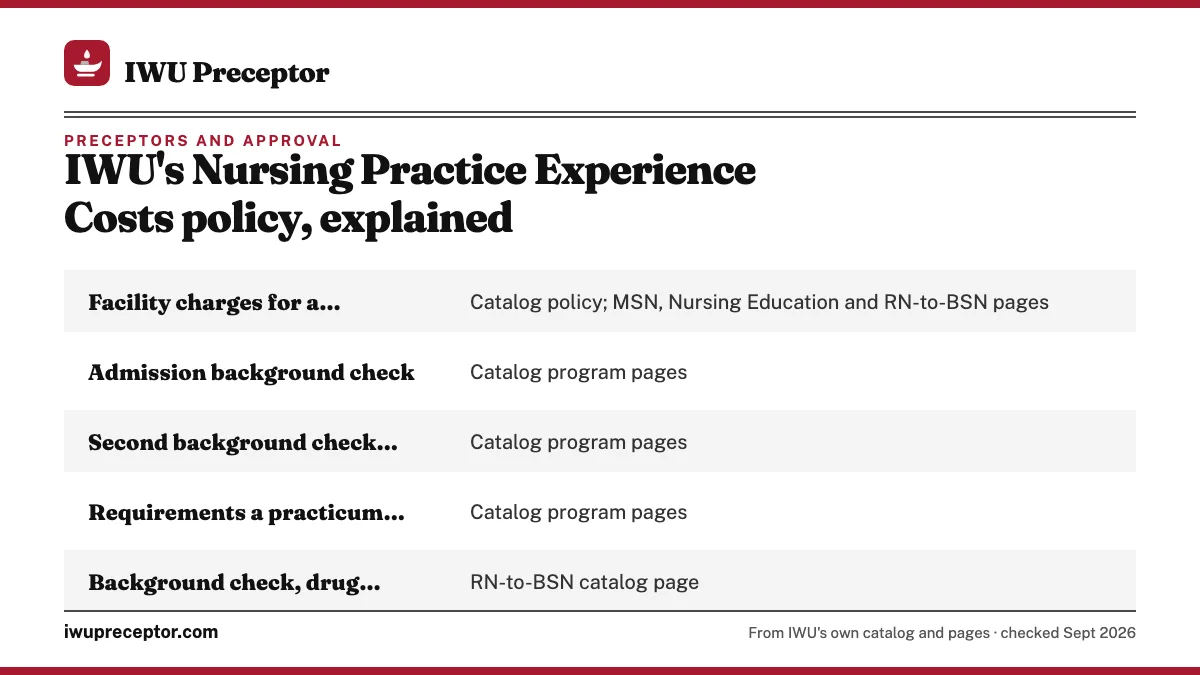
Reading the policy together with IWU's program and catalog pages gives a clear picture of the costs that land on the student.
| Cost | Where IWU states it | Who it affects |
|---|---|---|
| Facility charges for a placement | Catalog policy; MSN, Nursing Education and RN-to-BSN pages | All National & Global nursing students |
| Admission background check | Catalog program pages | Masters Nursing tracks |
| Second background check, drug screen, health clearance, immunizations | Catalog program pages | APRN students before the first clinical |
| Requirements a practicum agency adds | Catalog program pages | Graduate students |
| Background check, drug testing, immunization tracking if the facility requires them | RN-to-BSN catalog page | RN-to-BSN students |
| Residency travel | DNP program page | DNP Systems Leadership students |
| Immersion or global travel | DNP program page; IPE-402 course page | DNP students; optional for RN-to-BSN |
| Competency exams and audits after six months out | MSN FNP catalog page | NP students re-entering |
Compliance costs before your first clinical
Compliance spending starts early. The first bill arrives at admission: a criminal background check, which Masters Nursing students complete and pay for within six weeks of starting. Ahead of the first practicum course, APRN students fund a repeat background check, a drug screen, health clearance and the immunizations the catalog lists for NP tracks, namely TB, rubella, MMR, flu and hepatitis B.
Practicum agencies can add their own requirements, and IWU's catalog says students meet all of them at their own expense before patient contact. Random or reasonable-suspicion drug testing can also happen at any time during the program.
Budget for these items at the start of the program rather than the month before a clinical, since a missing item can stall an otherwise ready placement. The background check and drug screen page and the immunizations and health clearance page go through each requirement.
Travel to Marion and beyond
Several programs bring you to campus. FNP master's students attend a health assessment residency, PMHNP master's students add two intensives to their residency, and the BSN-to-DNP catalog shows four residencies. The DNP in Systems Leadership has three residencies on the Marion campus, each four days or less, and IWU states that travel for them is at the student's expense.
Doctoral students also meet a global health requirement. The Systems Leadership catalog calls for domestic or international travel in the global healthcare course, and the program page lets students pick a local, domestic or international immersion, with the travel bill theirs. RN-to-BSN students who take the optional IPE-402 cross-cultural experience arrange its travel themselves.
For programs where IWU does not spell out who pays residency travel, plan as if it is yours and confirm with your program materials. The Marion residencies page lists each program's onsite dates and formats.
How the Marion BSN differs
On-campus pre-licensure students sit outside the National & Global policy. IWU arranges their clinicals in faculty-led groups of about five to eight students, and an annual nursing fee, listed in the catalog, covers malpractice insurance and the administrative costs of clinical placement. Because IWU arranges these placements, Marion students skip the preceptor search that online students run for themselves Clinicals begin in the sophomore year, inside courses that usually run 15 weeks.
Marion BSN students still complete their own clearance items, including annual TB testing, immunizations and a drug screen taken within 30 days before clinicals begin and then yearly. American Heart Association BLS must stay current throughout, and online-only CPR courses do not count. See the Marion BSN clinicals page for the full list.
The costs of a delayed clinical
The most expensive placement is often the one that comes too late. IWU's withdrawal policy requires any student sitting out a course to arrange it with the Office of Learner Success ahead of the start date, and a returning student's cohort placement may be delayed by enrollment limits.
Time away carries its own consequences. After more than 90 days out, a student may face a tuition increase, and after six months or more, curriculum changes apply. NP students away longer than six months also sit competency exams covering pharmacology, pathophysiology and physical assessment and record a full history-and-physical video, and they pay for the exams and any required audits.
An early, well-matched placement is the best protection against all of this. The delayed graduation page explains how a missing preceptor can push the timeline back.
Ask every prospective site up front whether it charges a placement or onboarding fee. Under IWU's policy, that charge is yours.
What shapes a quote for our service
Because IWU leaves placement costs to the student, many IWU students weigh a placement service against the weeks a solo search can take. Our quotes reflect the work involved: your program and course, the specialty (FNP primary care and PMHNP psychotherapy searches differ), your location, how soon the course starts and how many rotations you need covered.
Every quote covers the full scope of our work: a course-matched search in your community, preparation of what IWU vets, and support through the course, including a replacement if a preceptor drops. The cost page explains each factor, and the form below starts a quote. Asking early also helps: a quote requested well before the course opens leaves the widest pool of preceptors to choose from.
Questions IWU students ask
Does IWU charge a clinical placement fee for online nursing programs?
IWU publishes no paid placement option for its online programs. Its catalog policy instead states that any cost of clinical placement is the student's responsibility, which covers charges set by facilities. The on-campus BSN in Marion is different: an annual nursing fee there covers the administrative costs of clinical placement.
Will a clinical site charge me to take me as a student?
IWU's MSN pages anticipate that a facility may charge for a student placement, and they say that in that case the student pays. Ask about any placement, onboarding or badge charges before you commit, so the cost is known before approval paperwork starts and nothing surprises you once the course is underway.
Who pays for my background check and drug screen at IWU?
You do. IWU's catalog places the admission background check and the second background check, drug screen, health clearance and immunizations required before the first clinical at the student's expense. Any extra requirement a practicum agency sets is also yours to cover before patient contact.
Do I pay my own travel to IWU residencies?
For the DNP in Systems Leadership, IWU states that residency travel is at the student's expense, and DNP immersion travel is self-paid too. Other programs' pages are less explicit, so plan to cover your own travel and lodging for Marion residencies and confirm details in your program materials.
Does postponing a clinical course cost more at IWU?
It can. IWU's withdrawal policy warns of a possible tuition increase after more than 90 days out, and curriculum changes after six months. NP students out longer than six months must pass competency exams and submit a history-and-physical video, paying for exams and any audits themselves.
Related pages
Last checked 2026-09-24
We check these pages against IWU's own catalog and program pages. IWU's NP Clinical Guidelines, your syllabus and your program faculty have the final word.
IWU says you secure the site and preceptor. We make that the easy part.
Tell us your IWU program, your community and when your next practicum course starts. We find preceptors who fit the course and prepare everything IWU vets before it approves them.
- Preceptors matched to the course: primary care across the lifespan for the
PYCcourses, psychiatric care for PMHNP, leaders for HSL - Credentials, license and site details ready for IWU's review and Medatrax
- In your own community, in Indiana or wherever you live and hold your RN license
Start your placement plan
Program, city and start date is all we need to begin.