IWU BSN clinicals in Marion: faculty-led groups, courses and clinical clearance
In IWU's pre-licensure BSN and the accelerated Transition to Nursing program, IWU arranges your clinicals. From sophomore year on, you rotate through a range of healthcare systems in faculty-led clinical groups of roughly five to eight classmates. Your part is to keep every clearance item current so nothing stops you from attending.
Get your placement plan
Tell us your IWU program and where you live. A placement advisor replies with the preceptor and site options that fit your IWU course.
How IWU places BSN students
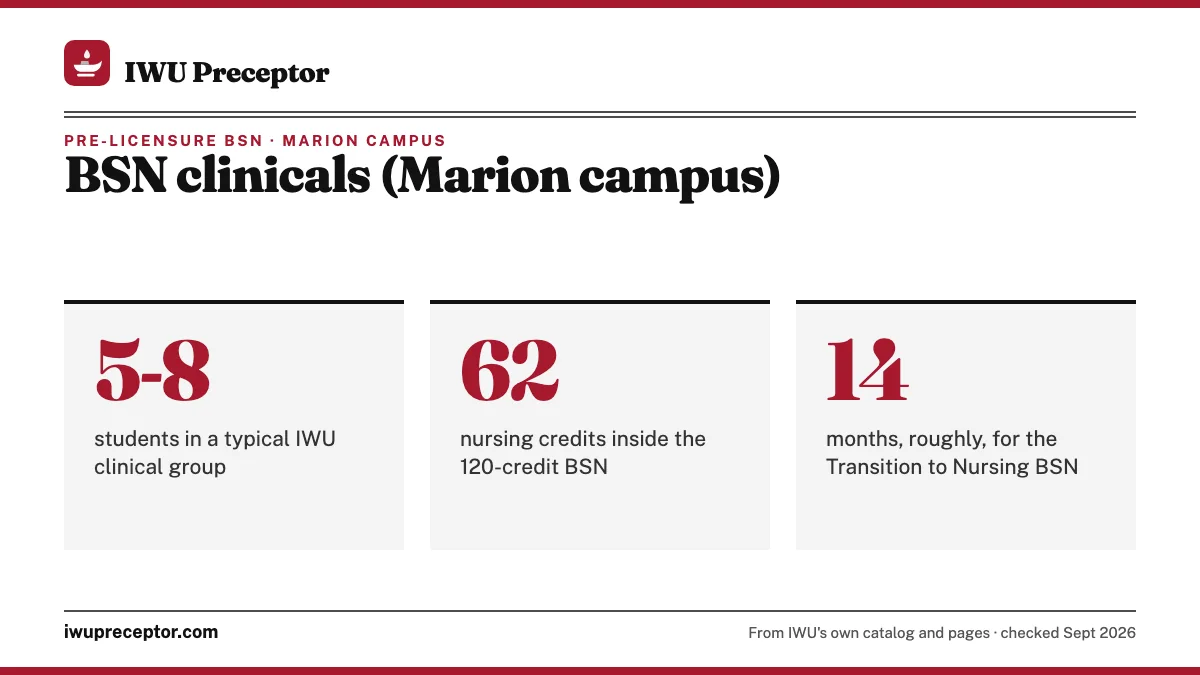
Pre-licensure clinicals at IWU are arranged by the university, not by students. IWU's program page describes placements in a range of healthcare systems, with clinical groups of about five to eight students and a faculty member guiding each group. Clinicals begin in the sophomore year.
Nursing courses run in the fall and spring semesters on the Marion campus and usually last 15 weeks. IWU's School of Nursing and Health Professions houses the program through its Division of Pre-licensure Nursing, and a Clinical Coordinator tells students when to complete time-sensitive steps such as the drug screen.
IWU charges annual clinical fees that cover malpractice insurance and the administrative costs of clinical placement; the amount is listed in the catalog. That arrangement is the opposite of IWU's graduate NP programs, where students secure their own preceptors, a difference securing sites and preceptors explains.
Routes into the major
The four-year BSN is 120 credits with 62 in nursing. A Fast-Track route takes about three years and asks for a TEAS score above 70% or a HESI A2 of 80%. High-school seniors who qualify can enter through IWU's GAP acceptance pathway, which the catalog describes on its nursing admission page.
Entry to the nursing major at the sophomore level requires 29 credits, a 2.75 GPA, C or better in the science prerequisites, a TEAS of 65% or HESI A2 of 75%, in-person American Heart Association BLS certification and a certified background check. Entry points are September and January, and the nursing coursework must be completed within 4.5 years.
Transition to Nursing is the accelerated option: 64 nursing credits over about 14 months in Marion, for students with a prior bachelor's degree (GPA 2.75) or on the 3+1 articulation route. It needs a TEAS above 70% or HESI A2 of 80%, lab sciences no more than five years old, and accepts no transfer credit for nursing lab or clinical courses. IWU strongly encourages Transition students not to hold outside jobs.
The clinical courses
The catalog marks the following courses as carrying clinical or practicum work. It publishes no clinical hour totals for any of them. Transition to Nursing uses the same clinical set, with NUR-226 in place of NUR-221 and NUR-232, and adds NUR-450.
| Course | Title | Credits | Population or setting |
|---|---|---|---|
NUR-246 | Care of the Ill Adult I | 4 | Ill adults; secondary and tertiary prevention |
NUR-249 | Care of the Well Adult | 4 | Adult health promotion |
NUR-349 | Care of the Ill Adult II | 5 | Complex adult conditions |
NUR-353 | Care of the Childbearing Family | 3 | Maternal and newborn care |
NUR-357 | Nursing Care of Children | 3 | Infants, children and adolescents |
NUR-400L | Transcultural Nursing-Practicum | 1 | A culture or subculture in the US or abroad |
NUR-449 | Critical Care Nursing | 5 | Acute and critical care |
NUR-470 | Community and Population Health | 4 | Community, non-institutional settings |
NUR-471 | Mental Health Nursing | 4 | Acute and chronic mental health |
NUR-473 | Nursing Leadership | 5 | Leadership and transition to practice; the capstone clinical |
Order matters. NUR-246 and NUR-249 open the sequence once you are admitted to the major, alongside the NUR-221 or NUR-232 skills labs. NUR-349, NUR-353 and NUR-357 build on those two, and NUR-449 and NUR-471 follow NUR-349, NUR-353 and NUR-357. NUR-470 and NUR-473 come after the 300-level courses, and NUR-485 Senior Seminar in the final semester focuses on NCLEX preparation.
Your clinical clearance checklist
IWU keeps pre-licensure clearance records in a secure online document management system, and the background check runs through a company the Division approves. The Division lists these requirements:
- Annual tuberculosis testing
- MMR: proof of two doses, or titers
- Hepatitis B: the full three-dose series
- Tdap vaccination
- Varicella immunity, shown by two doses or a titer
- A flu vaccine each season
- IWU's Health Clearance Form, completed
- A drug screen before your first clinical and again each year, within 30 days of clinicals starting; the IWU Health Center offers it
- American Heart Association BLS, kept current for the whole program; online-only courses are not accepted
Clinical agencies can add drug screens of their own. Immunizations and health clearance and background check and drug screen explain each item in more depth.
Online-only CPR does not count: IWU requires in-person American Heart Association BLS, current throughout the program.
Licensure, approval and accreditation
Finishing the BSN makes you eligible to sit the NCLEX-RN, whether in Indiana or elsewhere. IWU's 2022 professional licensure disclosure for the BSN says the curriculum satisfies licensure education requirements in every state plus the District of Columbia.
The Indiana State Board of Nursing's approved-programs list, printed July 2026, lists IWU's Traditional BSN as holding "Full Accreditation". CCNE accredits IWU's baccalaureate nursing program through a term that ends June 30, 2030, and CCNE's next visit is due in fall 2029. Nursing accreditation covers each IWU program's standing.
Accreditation matters again if you go on to graduate study. IWU's own MSN tracks, for example, admit BSN graduates of programs accredited by CCNE, ACEN or CNEA.
Where we fit for IWU nurses
Your BSN clinicals are in IWU's hands, and that is how it should be. The picture changes if you return for an MSN, DNP or leadership degree, because those programs ask you to secure your own sites and preceptors, and that is the work we specialize in. When that day comes, we find preceptors in your community for each course and prepare what IWU vets; the MSN FNP page shows what the graduate clinical path involves.
Questions IWU students ask
Do IWU BSN students find their own clinical placements?
No. In the pre-licensure BSN and Transition to Nursing, IWU arranges clinicals in a range of healthcare systems, with faculty-led groups of about five to eight students. Your annual clinical fees cover malpractice insurance and the administrative costs of placement. Students focus on clearance, preparation and performance.
When do clinicals start in IWU's nursing program?
Clinicals begin in the sophomore year, after admission to the nursing major. Entry points are September and January, and you need 29 credits, a 2.75 GPA, the required TEAS or HESI A2 score, in-person BLS and a certified background check to enter. The first clinical courses are NUR-246 and NUR-249.
Can I work while in IWU's Transition to Nursing program?
IWU strongly encourages Transition to Nursing students not to hold outside jobs. The program compresses the BSN nursing sequence into about 14 months on the Marion campus, with clinical groups scheduled by IWU. If you must work, talk with the program before you enroll.
How long is IWU's Fast-Track BSN?
About three years instead of four, according to IWU's program page. It asks for a stronger entrance score than the standard route: a TEAS above 70% or a HESI A2 of 80%. Clinical placements work the same way as on the four-year route, with IWU arranging faculty-led clinical groups.
Does online CPR count for IWU nursing clinicals?
No. IWU requires American Heart Association BLS, and online-only courses are not accepted. Certification must be in person and kept current throughout the program, alongside your immunizations and annual TB testing. Check your card's expiry date against your clinical calendar each semester.
What does IWU's BSN clinical fee cover?
The catalog says the annual clinical fees cover malpractice insurance and the administrative costs of clinical placement. The current amount is listed in IWU's catalog. Separate costs, such as immunizations, titers or an agency's own drug screen, may still fall to you depending on the requirement.
Related pages
Last checked 2026-09-24
We check these pages against IWU's own catalog and program pages. IWU's NP Clinical Guidelines, your syllabus and your program faculty have the final word.
IWU says you secure the site and preceptor. We make that the easy part.
Tell us your IWU program, your community and when your next practicum course starts. We find preceptors who fit the course and prepare everything IWU vets before it approves them.
- Preceptors matched to the course: primary care across the lifespan for the
PYCcourses, psychiatric care for PMHNP, leaders for HSL - Credentials, license and site details ready for IWU's review and Medatrax
- In your own community, in Indiana or wherever you live and hold your RN license
Start your placement plan
Program, city and start date is all we need to begin.