The IWU clinical placement process, from first search to first shift
At Indiana Wesleyan University, NP students find their own preceptor and clinical site with program faculty beside them, and the university vets and approves every one. After that come Medatrax, a second round of compliance checks, the first clinical day and faculty site visits. This page lays out the order and tells you where each step's fine print is kept.
Get your placement plan
Tell us your IWU program and where you live. A placement advisor replies with the preceptor and site options that fit your IWU course.
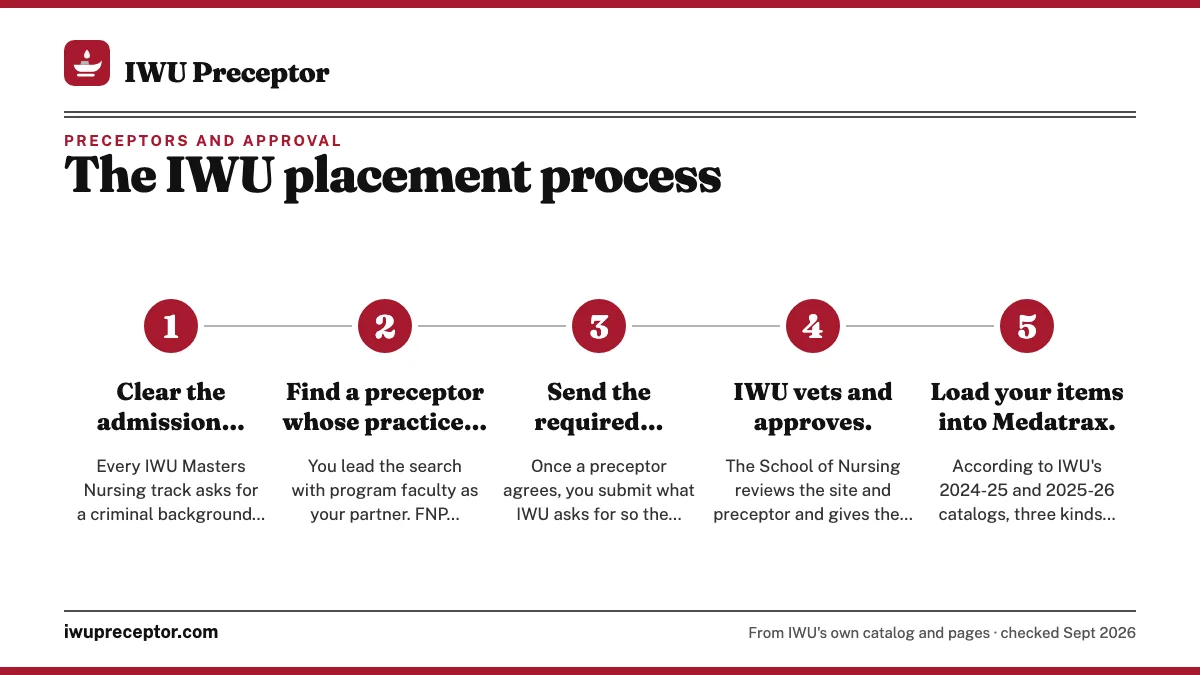
The short version: you find, IWU approves
IWU states its rule plainly on the post-graduate FNP certificate page: "Students are responsible for securing clinical sites and preceptors." The same page explains that you work with program faculty, that you are the one who identifies possible preceptors and sites, and that each site and preceptor goes through university vetting and approval once your documentation is in. The approval itself, in IWU's wording, belongs to the School of Nursing.
Two more details from that page shape your timeline. Clinical training happens in your own community, and clinical courses begin early in the program, so IWU tells students to have possible preceptors in mind well before they need them. IWU's public pages and catalog describe no placement office, preceptor database or paid placement route.
This applies to the online programs run by IWU National & Global. Pre-licensure BSN students in Marion are different: IWU places them in faculty-led clinical groups, covered on the Marion BSN clinicals page.
Step by step through IWU's placement path
- Clear the admission background check.Every IWU Masters Nursing track asks for a criminal background check at your expense, completed within six weeks of your program start. It comes long before any clinical course.
- Find a preceptor whose practice suits the course.You lead the search with program faculty as your partner. FNP rotations lean on primary care and outpatient settings across the lifespan; PMHNP course pages set hours course by course.
- Send the required documentation.Once a preceptor agrees, you submit what IWU asks for so the site and preceptor can be reviewed. Form names and lead times are kept in IWU's NP Clinical Guidelines and course materials.
- IWU vets and approves.The School of Nursing reviews the site and preceptor and gives the approval. IWU does not post an approval turnaround, so build in slack before the course opens.
- Load your items into Medatrax.According to IWU's 2024-25 and 2025-26 catalogs, three kinds of items go into Medatrax: approvals for the site and preceptor, your health records and compliance education.
- Finish pre-clinical compliance.Repeat the background check, add a drug screen, health clearance and immunizations, and meet any extras your site sets, all paid by you and done before patient contact.
- Begin the clinical and log with care.Expect faculty visits and evaluations during each FNP clinical course. Keep the log exact, because invented hours end an IWU program on the spot.
Where Medatrax and the week-two deadline fit
IWU's 2024-25 and 2025-26 catalogs attach a deadline to those Medatrax items. A student whose preparatory practicum requirements are still missing in week two of a practicum course may be dismissed. Uploading each item as soon as it is ready, rather than in one late batch, keeps you well clear of that cutoff.
IWU's 2026-27 pages leave that sentence out without naming any replacement system. Treat Medatrax and week two as the working rule, and check your syllabus before each clinical course for the current expectation.
In practice, this means approval and compliance cannot trail behind the course start. A preceptor who says yes the week a course opens leaves almost no room for review, uploads and checks. Our Medatrax guide walks through what each category holds.
Compliance checks before your first clinical
IWU sets a second compliance gate for APRN students that sits between approval and patient care. Before any patient contact, IWU wants a fresh criminal background check, a drug test, health clearance and current immunizations from you, together with anything the practicum agency adds, each at your own cost. Random or reasonable-suspicion drug testing can happen at any point, and IWU dismisses students who do not comply.
The MSN NP catalog pages spell out the immunizations: tuberculosis screening, rubella, MMR, influenza and hepatitis B, while BSN-to-DNP pages ask about TB, rubella and hepatitis B status. IWU may pass these records, along with your background check and drug-test results, to a site that requests them.
Your license matters here too. You need an active RN license, with no encumbrance, in each state that hosts one of your practicum sites, and a lapse in that status means administrative withdrawal. The background check and drug screen page covers the testing side in more depth.
Marion residencies run alongside the clinicals
Several IWU programs pair community clinicals with time on the Marion campus. For MSN FNP students, PYC-660 brings an onsite advanced health assessment residency. The MSN PMHNP adds two onsite intensives to its residency. Systems Leadership DNP students attend three residencies, none longer than four days, and pay their own travel; the BSN-to-DNP catalog counts four. For the post-graduate FNP certificate, the web FAQ describes one residency weekend while the catalog says students "may need to attend", so confirm yours with program faculty.
Residency days are not preceptor hours, but they compete for the same calendar. Tell your preceptor early when you will be in Marion so the clinical schedule can flex around it. The Marion residencies page sets out each program's onsite requirement.
The fine print IWU keeps in its guidelines
IWU publishes the shape of the process but not its paperwork. Public IWU sources give no lead time for securing a placement, no names for preceptor agreements or license verifications, no approval turnaround and no role-by-role sign-off chain beyond the university and the School of Nursing.
IWU keeps those details in documents it names without publishing: its NP Clinical Guidelines, the School of Integrated Health Student Handbook found inside each course, and the DNP Project Manual for doctoral students. Your course syllabus and program faculty fill in the rest. Our guide to the NP Clinical Guidelines lists the questions worth answering from them first.
The slip students make most often: waiting for a clinical course to open before searching. IWU says clinicals start early in the program, so the search should start earlier still.
Why IWU students hand the search to us
We are specialists in IWU's clinical process, and our service is built around each step above. We search your own community for a preceptor and clinical setting suited to the exact IWU course you are taking, confirm the preceptor is willing to host faculty visits and evaluations, and gather everything IWU reviews, from the preceptor's credentials and license to the site's details.
IWU gives the final approval on every site and preceptor. Our part is to put a complete, rule-ready file in front of the School of Nursing on the first pass, so review time goes to approving rather than chasing missing pieces. Should a preceptor leave partway through, the replacement search begins immediately. The how it works page lays out every step.
Questions IWU students ask
How early should I start looking for an IWU preceptor?
IWU does not post a set number of months. What it does say is that clinical courses begin early in the program and that students should line up possible preceptors in advance. Pull the current window from the NP Clinical Guidelines or ask your program faculty, then start before that window so approval and compliance have room to finish.
Does IWU find clinical sites for online nursing students?
For the online NP programs, no placement office or site database is published. IWU's rule is that students secure their own sites and preceptors, working with program faculty, and the university approves each one. Marion's pre-licensure BSN runs differently: IWU places those students in faculty-led clinical groups.
Who signs off on my preceptor at IWU?
Approval rests with what IWU's program pages call the School of Nursing, following the university's vetting. Doctoral practicum hours get their sign-off from course faculty or a designated academic leader instead. IWU does not publish a more detailed sign-off chain, so ask your program faculty who reviews submissions for your course.
Can I see patients before my Medatrax items are complete?
IWU's catalogs say compliance must be complete before any patient contact, and its recent catalogs expect Medatrax submissions by the second week of a practicum course, with dismissal possible after that. Plan on having approval and compliance finished before your first clinical day, and check your syllabus for the exact expectation.
Do I have to do IWU clinicals in Indiana?
IWU expects clinical training to take place in your own community, wherever you live, and asks for a current, unencumbered RN license in each state that hosts a practicum site. Out-of-state students follow their own state's rules as well. The clinicals outside Indiana guide covers the details.
Related pages
Last checked 2026-09-24
We check these pages against IWU's own catalog and program pages. IWU's NP Clinical Guidelines, your syllabus and your program faculty have the final word.
IWU says you secure the site and preceptor. We make that the easy part.
Tell us your IWU program, your community and when your next practicum course starts. We find preceptors who fit the course and prepare everything IWU vets before it approves them.
- Preceptors matched to the course: primary care across the lifespan for the
PYCcourses, psychiatric care for PMHNP, leaders for HSL - Credentials, license and site details ready for IWU's review and Medatrax
- In your own community, in Indiana or wherever you live and hold your RN license
Start your placement plan
Program, city and start date is all we need to begin.