IWU's 800 patient encounters, and how to reach each count
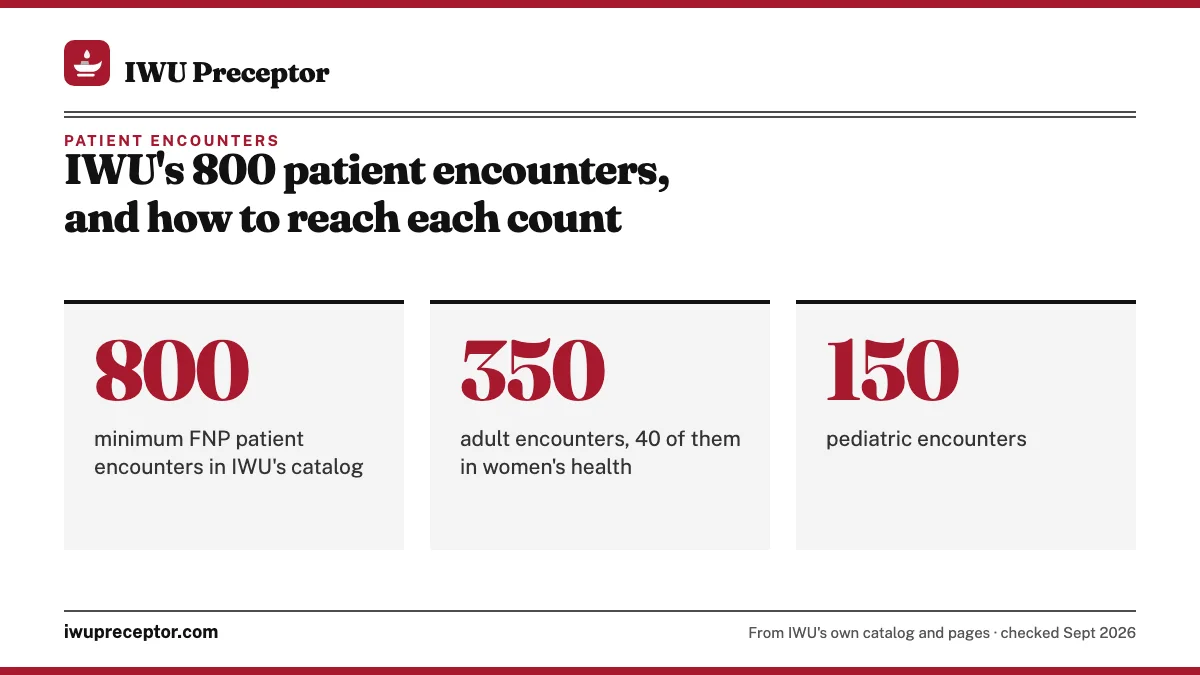
Alongside its practicum hours, IWU's MSN FNP asks for at least 800 patient encounters. At least 350 must be adults, including 40 in women's health, and no fewer than 150 must be children. Those counts decide which preceptors you need just as much as the hour total does.
Get your placement plan
Tell us your IWU program and where you live. A placement advisor replies with the preceptor and site options that fit your IWU course.
The encounter rule in IWU's catalog
Both master's-level FNP entries in the 2026-27 catalog, the standard MSN and the ASN-to-MSN, carry the rule right beside the 850-hour practicum requirement covered on our FNP hours page. Each figure is a minimum, so hitting a number exactly is the least you can graduate with, not a target to aim at.
| Category | Minimum | How the catalog frames it |
|---|---|---|
| All patient encounters | 800 | At least 800 across the program |
| Adult | 350 | At least 350 adult encounters |
| Women's health | 40 | Counted inside the 350 adult encounters |
| Pediatric | 150 | At least 150 pediatric encounters |
| Unassigned remainder | 300 | 800 minus 350 minus 150; the catalog ties these to no population |
Two details trip students up. The 40 women's health encounters sit inside the adult 350 rather than on top of it, and the catalog does not assign the remaining 300 to any particular group of patients.
What the numbers mean day to day
Spread across 850 hours, 800 encounters works out to a little under one patient per clinical hour. That is an average over the whole program, not a pace IWU sets for any single course or clinic day. A busy walk-in session will run well above it, and a day of long chronic-care visits will run below it.
If your sites mostly see adults, the pediatric count is the one that falls behind. General primary-care schedules can fill the adult 350 without much planning, but 150 children need a preceptor whose panel includes kids as a routine part of the week.
Women's health follows the same pattern on a smaller scale. Forty encounters is a modest number, yet it only comes easily when at least one of your preceptors sees women's health patients regularly.
Sites that build each count
Match the setting to the count you need. These are the four rotation settings IWU's FNP certificate FAQ names for the PYC courses, and each one feeds the encounter rule differently.
- Family practice: adults and children in the same schedule, the most flexible base for all three counts.
- Pediatrics: the direct route to 150 pediatric encounters when your family practice leans toward adults.
- Internal medicine: a steady adult caseload that builds the 350 quickly but adds nothing to pediatrics.
- Women's health: fills the 40 women's health encounters and raises your adult total at the same time.
That FAQ also limits specialty time to a minority of your hours, with primary care making up the rest. A specialty clinic may add little to the pediatric or women's health counts, so check with course faculty before you give it clinic days.
Planning the counts across the PYC sequence
IWU publishes no per-course encounter targets, and the catalog pages for PYC-670 through PYC-683 give no hour splits either. Any course-level expectation will be in that course's syllabus. IWU's pages point to the NP Clinical Guidelines for practicum rules, so ask faculty there how an encounter is defined and counted.
A practical plan tallies all three counts after every clinic day and looks ahead at each course change. If you reach the middle of the sequence with pediatrics well behind, line up a pediatric-heavy preceptor for the next course instead of hoping PYC-683 catches you up.
Record every encounter accurately. IWU dismisses students who falsify clinical hours at once, and your encounter tally deserves the same care; our page on logs and integrity covers the habits that keep a record clean.
Who the encounter rule covers
IWU's catalog spells out the 800-encounter minimum in its two master's-level FNP entries. The FNP certificate's catalog entry sets its 780-hour minimum without listing encounter counts, and the BSN-to-DNP FNP entry frames its requirement as 1,000 practicum hours. If you are in either of those tracks, ask faculty whether the same counts apply, and plan as if they do until someone tells you otherwise.
ASN-to-MSN students start counting later than the name suggests. No FNP clinical time is attached to the bridge courses at the front of the program, so encounters build only once you reach the PYC clinical courses, which makes a strong preceptor line-up for those courses even more valuable.
IWU's PMHNP, leadership and education programs state their clinical requirements in hours. For those tracks, the clinical hours hub is the better starting point.
How we plan sites around your counts
We plan from your encounter gaps as well as your hour gaps. When your placement advisor searches your community, each preceptor profile covers who the practice sees: the age mix, whether women's health visits are routine, and how full a typical clinic day runs. That lets us pair a family practice with a pediatric or women's health preceptor whenever one site alone would leave a count short.
Once a match is set, the paperwork IWU vets is gathered and checked for you, from the preceptor's license to the practice address, so nothing is missing when approval is requested. Every site and preceptor still needs IWU's sign-off; what we hand over is a complete, rule-ready file. Partway through the sequence and short on a count? Tell us through the form below, or see the page for students behind on clinical hours.
Questions IWU students ask
Do women's health encounters count toward IWU's 350 adult encounters?
Yes. The catalog wording sets at least 350 adult encounters, 40 of them in women's health, so those 40 are part of the adult minimum rather than an extra block. A women's health clinic day therefore moves two counts at once: your adult total and your women's health total.
What counts as a patient encounter in IWU's FNP program?
IWU does not define an encounter on any public page. The definition, and any rule about how shared visits or brief follow-ups are counted, would sit in the NP Clinical Guidelines or your course syllabus, neither of which is published. Ask your course faculty before your first clinical day so your log matches their expectations from the start.
How many pediatric encounters does IWU require for the FNP?
At least 150, according to the 2026-27 catalog entries for the MSN FNP and ASN-to-MSN FNP. IWU publishes no separate pediatric hour figure and no rule on which course must produce them, so you can build the count across the PYC sequence. A pediatric or family practice preceptor makes it far easier to reach.
Can I have enough FNP hours but too few encounters?
Yes. The catalog lists the 850 hours and the 800 encounters as separate minimums, and meeting one does not satisfy the other. Watch the adult, women's health and pediatric counts alongside your hour log, and raise any shortfall with course faculty while a preceptor in the right setting can still be added.
Does telehealth count toward IWU's encounter totals?
IWU publishes no rule on telehealth, inpatient or urgent care time for its FNP students. Because the certificate FAQ expects most hours in primary care, confirm with course faculty whether telehealth visits count before you schedule them, and record them the way your syllabus asks.
Related pages
Last checked 2026-09-24
We check these pages against IWU's own catalog and program pages. IWU's NP Clinical Guidelines, your syllabus and your program faculty have the final word.
IWU says you secure the site and preceptor. We make that the easy part.
Tell us your IWU program, your community and when your next practicum course starts. We find preceptors who fit the course and prepare everything IWU vets before it approves them.
- Preceptors matched to the course: primary care across the lifespan for the
PYCcourses, psychiatric care for PMHNP, leaders for HSL - Credentials, license and site details ready for IWU's review and Medatrax
- In your own community, in Indiana or wherever you live and hold your RN license
Start your placement plan
Program, city and start date is all we need to begin.