Who can precept an IWU nurse practitioner student
IWU keeps its preceptor qualification standards in its NP Clinical Guidelines rather than on public pages. What it does publish, from FNP setting rules to PMHNP course focus and one education course's master's-prepared preceptor, already narrows the field. State law then adds its own layer.
Get your placement plan
Tell us your IWU program and where you live. A placement advisor replies with the preceptor and site options that fit your IWU course.
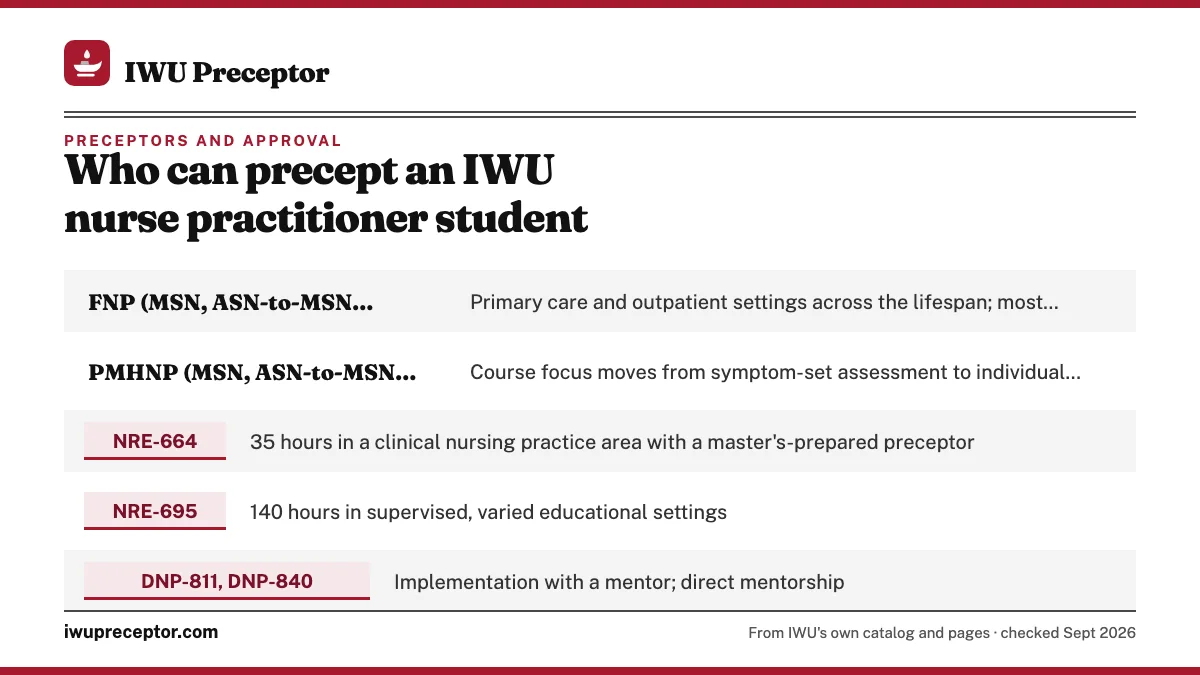
What IWU publishes and what it keeps in the guidelines
A careful search of IWU's catalog and program pages turns up no public list of preceptor credentials. Which clinician types may precept, how many years of experience they need, whether board certification is required, and how many students one preceptor may take are not stated anywhere public.
The standards do exist. An IWU article on RN-to-BSN and MSN pathways lists preceptor qualifications as one of the conditions a workplace site has to meet, alongside faculty oversight and learning objectives, without spelling them out. IWU's catalog and program pages point to the NP Clinical Guidelines and student handbooks for practicum rules, and that is where the qualification list lives.
So the first move is simple: read the current NP Clinical Guidelines for your track before you approach anyone. Our NP Clinical Guidelines page lists what to look up first.
What each program tells you about the right preceptor
Even without a credential list, IWU's published course and setting descriptions tell you a lot about the kind of practice a preceptor needs.
| Program or course | What IWU publishes | Where to confirm |
|---|---|---|
| FNP (MSN, ASN-to-MSN, certificate) | Primary care and outpatient settings across the lifespan; most hours in primary care, some specialty hours possible | NP Clinical Guidelines, syllabus |
| PMHNP (MSN, ASN-to-MSN, certificate) | Course focus moves from symptom-set assessment to individual, family and group psychotherapy and complex clients | NP Clinical Guidelines, syllabus |
NRE-664 | 35 hours in a clinical nursing practice area with a master's-prepared preceptor | Course syllabus |
NRE-695 | 140 hours in supervised, varied educational settings | Course syllabus |
DNP-811, DNP-840 | Implementation with a mentor; direct mentorship | DNP Project Manual |
HSL-688P | 130-hour capstone immersion at a location you choose | Program faculty |
NRE-664 is the only IWU course whose public description names a preceptor credential. For every NP course, the qualification detail sits in the guidelines.
Setting rules that shape the choice
For FNP students, the setting rule matters as much as the preceptor's title. IWU directs rotations toward family practice, internal medicine, pediatrics and women's health, all in primary care or outpatient care. A preceptor in a narrow specialty may fit a small slice of hours at most, because most FNP hours must be in primary care.
The encounter minimums point the same way. The catalog asks for at least 800 patient encounters, with 350 or more adult (40 of them women's health) and at least 150 pediatric. A preceptor whose panel is almost all adults can leave the pediatric count short, so the practice's patient mix is part of the qualification in practice.
For PMHNP students, no public setting rule exists, but each course's focus does the same job. PMHN-630 works with individual patients, PMHN-640 with families and groups, and PMHN-650 with clients who have multiple conditions. IWU's public pages say nothing about limits on inpatient, urgent care or telehealth hours, so check the guidelines before counting them.
State rules add their own layer
Your preceptor practices under the laws of the state where the site sits, and IWU ties your own eligibility to that same state. The catalog ties your eligibility to an RN license that is active and unencumbered in each practicum state, and every other license you hold must be clean as well. Some states also add steps of their own; IWU's 2022 licensure disclosures for its NP programs flag New Hampshire, New York and Rhode Island in that way.
Indiana adds a detail worth knowing. State law requires an APRN to work in collaboration with a licensed practitioner, typically shown by a written practice agreement, and prescriptive authority depends on that agreement. IWU's FNP certificate content addresses Indiana scope of practice, and IWU advises students who plan to practice elsewhere to check that state's rules. Our page on Indiana APRN practice and preceptors explains the effect on who can precept, and clinicals outside Indiana covers other states.
What makes a strong preceptor for an IWU course
Beyond whatever the guidelines require, the preceptors who work best for IWU students tend to share a few traits. These are the qualities we look for in every match:
- A practice whose patients match the course, such as a family panel with children for the pediatric count.
- Enough daily volume to support both hours and encounters without long idle stretches.
- Time and interest in teaching, with room for the student to take histories, examine and present.
- Willingness to host IWU faculty site visits and complete evaluations.
- Stability at the site for the full length of the course, which runs 7 to 15 weeks for FNP courses.
- Comfort with paperwork, since IWU's review and the course evaluations both depend on the preceptor's input.
Questions to settle in the guidelines first
- Which clinician types may precept each course in your track.
- Any minimum years of practice or certification for preceptors.
- Whether one preceptor may supervise more than one student at a time.
- Whether a relative, friend or direct supervisor may serve as your preceptor.
- How many specialty hours an FNP course will accept.
- Whether telehealth, inpatient or urgent care hours count, and in what share.
- What documentation the preceptor provides and signs.
Settle these before asking a clinician to commit. A preceptor who agrees and then turns out not to meet IWU's standards costs you weeks you may not have.
Do not assume last year's answer still holds. Read the version of the NP Clinical Guidelines that applies to your current course.
How we match preceptors to IWU's standards
Matching a preceptor to IWU's standards is the core of what we do. We start from your course and your community, shortlist clinicians whose practice fits IWU's published setting rules, and confirm their credentials and license before anyone is put forward. Each shortlisted preceptor also hears in advance what an IWU course asks of them, from teaching time to faculty visits.
IWU makes the final approval call, and our preparation is aimed at making that call easy: a preceptor who fits the course, with the documents IWU reviews gathered in one place. See how approval works on the preceptor approval page, or send us your course details with the form below. Should a preceptor step back partway through, we start sourcing a replacement straight away.
Questions IWU students ask
Can a physician or PA precept an IWU FNP student?
IWU's public pages do not list which clinician types may precept, so the answer sits in the NP Clinical Guidelines for your track. Check the current version and confirm with your program faculty before approaching a physician or physician assistant, since the approval decision rests with IWU.
Does my IWU preceptor need to be board certified?
IWU does not state a certification requirement in its catalog or on its program pages. Certification, years of experience and similar standards, if IWU sets them, appear in the NP Clinical Guidelines. A preceptor's certification status is worth confirming early so it never becomes a late surprise in review.
Does my preceptor need an Indiana license?
Only if the site is in Indiana. The Indiana state sources we checked set no license rule for preceptors as such, but anyone practicing in Indiana needs Indiana authority: an Indiana or compact RN license, an APRN prescriptive license with a collaborative agreement, or an Indiana physician license. Your own RN license must be valid there too.
Can a psychiatrist precept an IWU PMHNP student?
IWU's public sources do not say which clinicians may precept PMHNP courses. The NP Clinical Guidelines hold that rule. Whoever precepts should practice in a way that fits the course focus, such as family and group therapy for PMHN-640, so check fit as well as credentials.
Do telehealth hours count at IWU?
IWU's public pages say nothing either way about telehealth, inpatient or urgent care hours. Before counting any of them toward a course, check the NP Clinical Guidelines and your syllabus, and ask course faculty if the answer is unclear. Hours that do not meet IWU's rules may not count.
Related pages
Last checked 2026-09-24
We check these pages against IWU's own catalog and program pages. IWU's NP Clinical Guidelines, your syllabus and your program faculty have the final word.
IWU says you secure the site and preceptor. We make that the easy part.
Tell us your IWU program, your community and when your next practicum course starts. We find preceptors who fit the course and prepare everything IWU vets before it approves them.
- Preceptors matched to the course: primary care across the lifespan for the
PYCcourses, psychiatric care for PMHNP, leaders for HSL - Credentials, license and site details ready for IWU's review and Medatrax
- In your own community, in Indiana or wherever you live and hold your RN license
Start your placement plan
Program, city and start date is all we need to begin.