IWU's 1,000-hour DNP rule
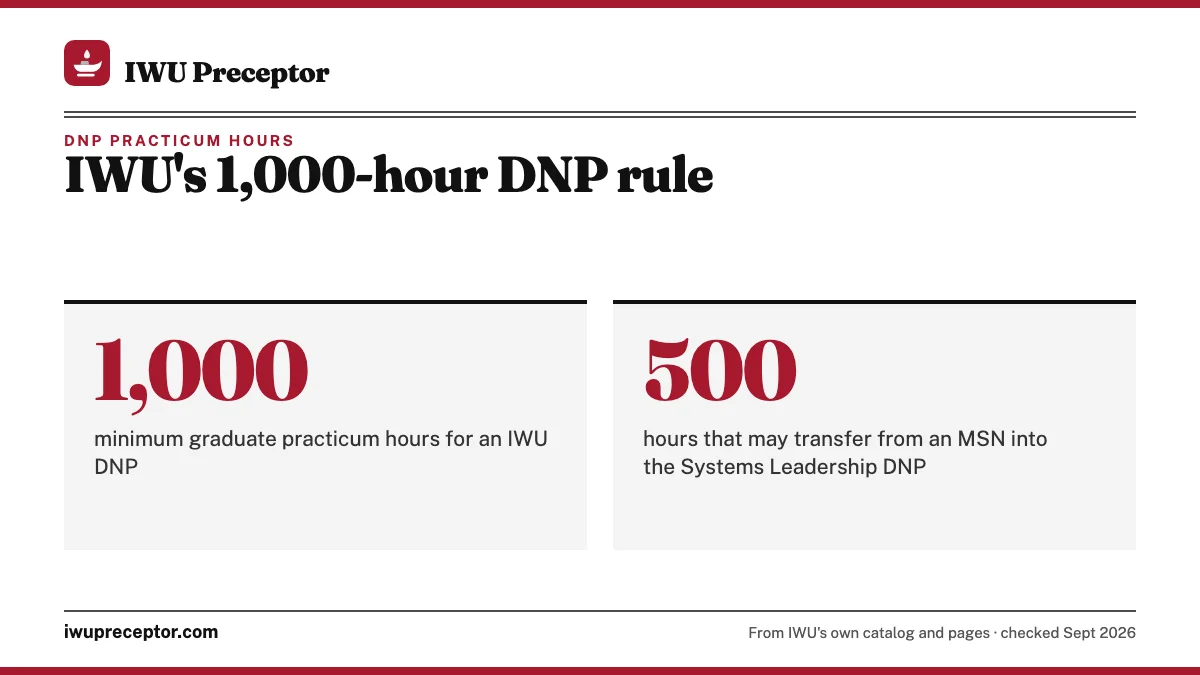
Every IWU Doctor of Nursing Practice student must complete a minimum of 1,000 graduate practicum hours. Post-master's students in Systems Leadership can bring up to 500 of them from their master's clinicals, according to IWU's DNP web page. BSN-to-DNP students build the whole 1,000 inside the program, through NP clinical courses and project work that faculty approve.
Get your placement plan
Tell us your IWU program and where you live. A placement advisor replies with the preceptor and site options that fit your IWU course.
One floor, three routes
IWU's catalog and web pages agree on the 1,000-hour floor for all three DNP programs. What differs is where the hours come from and how much of your earlier education can count, as the table shows. Whichever route you are on, the total is a minimum, not a target, and hours only count once your faculty accept them. For a comparison with IWU's master's programs, see the clinical hours hub.
| Route | Minimum | Transfer | Where hours build |
|---|---|---|---|
| DNP in Systems Leadership (post-master's) | 1,000 | Up to 500 from master's-level clinical experience (web page; the catalog states no cap) | DNP-810, DNP-811, DNP-812, DNP-840, plus DNP-830 or DNP-835 |
| BSN-to-DNP, FNP | 1,000 | Transferred credit cannot cover any practicum course | DNP-760, DNP-770, DNP-781 to DNP-783, plus the project courses |
| BSN-to-DNP, PMHNP | 1,000 | The same limit applies | DNP-752, DNP-728, DNP-790 to DNP-793, plus the project courses |
The 500-hour transfer for post-master's students
IWU's DNP web page says up to 500 hours may transfer from master's-level clinical experience. The 2026-27 catalog entry for the Systems Leadership DNP repeats the 1,000-hour minimum without stating that cap, so confirm the figure with program faculty before you rely on it.
The effect on your plan is large. A student credited with the full 500 needs another 500 inside the program, while a student whose master's clinical hours were fewer or poorly documented needs more. IWU does not publish how master's hours are verified, so ask early which records the program wants from your MSN school.
Systems Leadership also expects you to be actively licensed wherever your practicum takes place. It adds three onsite residencies in Marion, none longer than four days, plus a global health course with domestic or international travel at your own expense. Our Systems Leadership DNP guide covers the rest of that program.
How BSN-to-DNP hours accrue
In the BSN-to-DNP, hours accumulate from the clinical time built into particular courses, and from additional work or projects that faculty, or the program's designated academic leader, accept. The rules on what qualifies are in two documents IWU keeps off its public site: the NP Clinical Guidelines and the DNP Project Manual.
The NP courses carry much of the load. On the PMHNP track, DNP-752 is listed at 75 hours and DNP-728 at 150, with 175 for each of the three Psychotherapeutic Modalities courses, which comes to 750 before any project work. The FNP-track courses require supervised clinical experience, but IWU publishes no hours for them.
No transferred credit can replace a BSN-to-DNP practicum course, and the catalog spells out that this covers the NP practicums, health policy, cultural healthcare, graduate health assessment and the project courses. You also need a transcultural healthcare experience, and an NP practicum course is failed outright if you miss two or more of its workshops. Residency counts also differ by source: the FNP catalog entry lists four, the web page three, as our Marion residencies page explains.
Where DNP project hours happen
The DNP project courses are shared across routes. The catalog marks most of them as practicum courses but gives no hour figures, so your syllabus sets each course's target.
| Course | Credits | Practicum | What happens |
|---|---|---|---|
DNP-810 Assessment and Planning for Evidence-Based Practice | 5 | In the practice setting | Assess the practice environment and write the formal project proposal |
DNP-811 The Implementation of Evidence-Based Practice | 3-4 | With a mentor | Implement the project and secure regulatory approvals; follows DNP-810 |
DNP-812 Evaluation, Sustainability, and Dissemination of Evidence-Based Practice | 5 | Project course | Ends with public dissemination of findings |
DNP-830 Cultural Immersion in Health Systems | 1 | Regional, national or international | DNP-835 may substitute |
DNP-835 Healthcare Across Cultures | 1 | Regional | Used in both BSN-to-DNP tracks |
DNP-840 Advanced Nursing Practice Roles | 1-4 | Direct mentorship | Follows DNP-810 |
DNP-850 Advanced Nursing Practice Roles II | 2 | Optional practicum | Listed as optional in the Systems Leadership plan |
Settle your project site and mentor before DNP-810. That course assesses the very practice environment where you will implement and evaluate the project, so changing sites afterward means repeating groundwork.
Who approves DNP hours
The catalog gives approval of BSN-to-DNP practicum hours to course faculty or a designated academic leader. On the web, IWU adds a named role: DNP practicum work and exceptions go to the Dean of the Division of Doctoral Programs or a designated leader, and the Student Life Council has the last word on BSN-to-DNP exceptions.
Keep that chain in mind as you plan. A project site or mentor that looks right to you still needs faculty sign-off, and an exception request goes through named academic roles rather than through your mentor. Log hours only at sites and in activities your faculty have approved, and keep each approval in writing with your project records; our page on clinical logs and integrity explains why.
Why DNP students choose us
DNP students need two kinds of placement, and we source both. BSN-to-DNP students need NP preceptors for the FNP or PMHNP clinical courses, matched to each course's focus. Every DNP student needs a practice setting and mentor where an evidence-based project can be assessed, implemented and evaluated across DNP-810, DNP-811 and DNP-812.
Your placement advisor searches your own community for both, then prepares the credentials, license details and site information IWU's faculty review, so the request is complete when it reaches them. Faculty and IWU's academic leaders make the approval decisions, and the file they receive is built to IWU's rules from the start. Tell us your route and your next practicum course through the form below; how it works explains each step.
Questions IWU students ask
Does every IWU DNP student need 1,000 clinical hours?
Yes. All three routes, the BSN-to-DNP FNP, the BSN-to-DNP PMHNP and the post-master's DNP in Systems Leadership, set a floor of 1,000 graduate practicum hours. The difference is the starting point: post-master's students may bring up to 500 hours from master's clinicals, while BSN-to-DNP students build every hour during the program.
How do I prove my master's clinical hours for the IWU DNP transfer?
IWU does not publish the documentation it accepts. The DNP web page states the 500-hour cap, and the catalog entry repeats only the 1,000-hour minimum. Ask program faculty which records they need, for example transcripts or clinical logs from your MSN school, and request them early so the transfer is settled before your first practicum course.
Can I do my IWU DNP project at my own workplace?
IWU publishes no rule on this for the DNP. What the catalog does say is that DNP-810 takes place in the practice setting and DNP-811 involves a mentor, and Systems Leadership applicants submit a practice-issue statement for the project. Ask faculty whether your employer qualifies before you draft the proposal around it.
How long does IWU's BSN-to-DNP take?
On IWU's website the BSN-to-DNP is a lock-step program lasting roughly 48 months, and it must be completed within 78. The catalog text says about 51 months. The post-master's Systems Leadership DNP runs about 26 months by the catalog, or 24 months over 10 courses by IWU's program data, with four years allowed.
Does the cultural immersion count toward DNP practicum hours?
The catalog lists a practicum in both DNP-830 Cultural Immersion in Health Systems and DNP-835 Healthcare Across Cultures, but IWU prints no hour figure for either. The immersion can be local, domestic or international, and travel costs are yours. Your course syllabus will show how immersion time is credited.
Related pages
Last checked 2026-09-24
We check these pages against IWU's own catalog and program pages. IWU's NP Clinical Guidelines, your syllabus and your program faculty have the final word.
IWU says you secure the site and preceptor. We make that the easy part.
Tell us your IWU program, your community and when your next practicum course starts. We find preceptors who fit the course and prepare everything IWU vets before it approves them.
- Preceptors matched to the course: primary care across the lifespan for the
PYCcourses, psychiatric care for PMHNP, leaders for HSL - Credentials, license and site details ready for IWU's review and Medatrax
- In your own community, in Indiana or wherever you live and hold your RN license
Start your placement plan
Program, city and start date is all we need to begin.