IWU PMHNP clinical courses, PMHN-652 to PMHN-693, and the preceptor each one needs
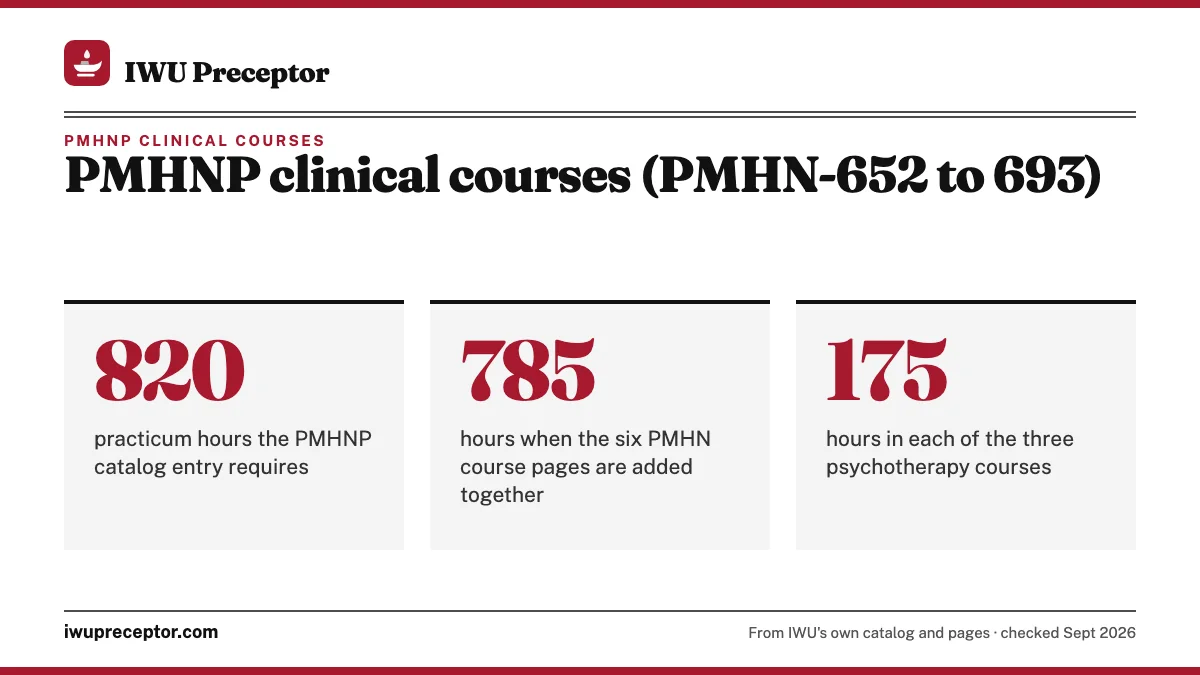
IWU's psychiatric-mental health NP track has six clinical courses, and unlike the FNP sequence each carries an hour figure on its catalog page: 75, 150, three courses of 175, and 35 plus an onsite intensive. Those pages add up to 785 hours, while the program entry requires at least 820. Plan for 820, and match each course to a psychiatric-mental health preceptor whose practice fits its focus.
Get your placement plan
Tell us your IWU program and where you live. A placement advisor replies with the preceptor and site options that fit your IWU course.
The six PMHNP clinical courses at a glance
IWU's 2026-27 catalog gives each clinical course in the MSN PMHNP its own credit value and hour count. IWU requires the program in its prescribed sequence but prints no prerequisites for individual PMHN courses, so check your cohort's course order in Self-Service.
| Course | Title | Credits | Hours | Catalog focus |
|---|---|---|---|---|
PMHN-652 | Advanced Health Status Assessment for the PMHNP | 4 | 75 | Assessment across the lifespan built around psychiatric symptom sets |
PMHN-628 | Foundations for PMHNP Practice | 5 | 150 | Interviewing, documentation and therapeutic communication |
PMHN-630 | Psychotherapeutic Modalities Across the Lifespan I | 5 | 175 | Individual patients |
PMHN-640 | Psychotherapeutic Modalities Across the Lifespan II | 5 | 175 | A variety of settings, with family and group therapy |
PMHN-650 | Psychotherapeutic Modalities Across the Lifespan III | 5 | 175 | Diverse clients with multiple conditions |
PMHN-693 | Interprofessional Development for the PMHNP | 1 | 35 + onsite intensive | Interprofessional simulation |
Two PMHNP courses have no clinical hours: PMHN-620 Neuro-Psychopharmacology and PMHN-622 Diagnostic Reasoning, each worth 2 credits. The shared PYC-602, PYC-614 and PYC-612 courses carry none either, so use those weeks to secure preceptors and move approvals forward.
Which hour total to plan around
IWU prints three different PMHNP totals. The catalog entry for the MSN PMHNP sets at least 820 practicum hours, and so do the ASN-to-MSN PMHNP and the post-graduate PMHNP certificate. IWU's MSN web page says 525, which happens to equal the three psychotherapy courses alone. The six course pages sum to 785, leaving 35 hours between the course figures and the program minimum that IWU does not explain.
Build your preceptor calendar for 820. If a syllabus assigns more hours than its catalog page, that may be where the extra 35 sit, but only faculty can confirm it. Our PMHNP hours page sets the three figures side by side and shows how to reconcile them with your own log.
Plan preceptor time to the 820-hour catalog minimum, not the 525 on the web page or the 785 course-page sum.
PMHN-652 and PMHN-628: assessment and foundations
PMHN-652 is the PMHNP version of advanced health assessment: 4 credits and 75 hours of assessment across the lifespan, organized around psychiatric symptom sets. A preceptor who runs psychiatric evaluations for new patients, from adolescents to older adults, gives you the most practice with structured history, mental status examination and screening tools.
PMHN-628 Foundations for PMHNP Practice adds 150 hours over 5 credits and centers on interviewing, documentation and therapeutic communication. An outpatient psychiatric practice or community mental health center where you can conduct intakes, write notes the preceptor reviews and sit in on medication-management visits fits this course well.
IWU publishes no setting rules for PMHNP clinicals and no public list of preceptor credentials; both belong to the NP Clinical Guidelines. Check them, and our preceptor requirements guide, before you ask a clinician to take you.
The psychotherapy courses: PMHN-630, PMHN-640 and PMHN-650
The three Psychotherapeutic Modalities Across the Lifespan courses carry 175 hours each, 525 together, which makes them the bulk of your PMHNP clinical time. Each has a different emphasis in the catalog, and that emphasis should shape the preceptor you choose.
PMHN-630 focuses on individual patients, so a practice where you can follow the same patients across several sessions works best. PMHN-640 moves into a variety of settings with family and group therapy; look for a site that runs therapy groups or family sessions, such as an intensive outpatient program or a community mental health center. PMHN-650 turns to diverse clients with multiple conditions, which points toward settings with complex caseloads, such as integrated care or clinics serving co-occurring mental health and substance use needs.
A single preceptor may not offer all three emphases. Planning a second site for PMHN-640 is often sensible, and IWU's approval process applies to each site and preceptor you add, so start that approval early.
Residency, intensives and PMHN-693
Onsite time in the MSN PMHNP comes in three pieces under the catalog: a residency focused on advanced health assessment plus two separate intensives, and the ASN-to-MSN PMHNP carries the same set. The PMHNP certificate lists a residency in advanced health assessment and a residency in the final course. The catalog does not name the location in the PMHNP entries, so confirm dates and place with faculty as soon as they post.
PMHN-693 Interprofessional Development for the PMHNP closes the sequence: 1 credit, 35 hours and an onsite intensive built on interprofessional simulation. IWU's MSN web page also describes live psychiatric evaluations with trained actors. The course page lists the 35 hours and the intensive separately, so ask faculty how the onsite days are credited, and tell your community preceptor early which weeks you will be away. See our residencies guide for how the onsite pieces compare across IWU programs.
The same pattern in other PMHNP routes
- ASN-to-MSN PMHNP: 66 credits, starting with 17 bridge credits, then the same PMHN clinical courses, 820 practicum hours, the residency and two intensives.
- Post-graduate PMHNP certificate: 32 credits covering
PYC-602and the eight PMHN courses, withPYC-602waived for certified NPs and 820 practicum hours; details are on the certificate page. - BSN-to-DNP PMHNP: doctoral counterparts
DNP-752(75 hours),DNP-728(150),DNP-790,DNP-791andDNP-792(175 each) andDNP-793with a 2-day onsite intensive, inside a 1,000-hour minimum.
Whatever the route, the pre-clinical rules match the MSN: a second background check, a drug screen and documentation of TB, rubella, MMR, flu and hepatitis B before the first practicum, plus an active, unencumbered RN license in each state where you train. Certificate students meet the pharmacology and pathophysiology prerequisites through an IWU course, IWU competency exams, or APRN certification plus 500 hours of practice in the past year.
Why IWU PMHNP students choose us
Psychiatric preceptors are a smaller pool than primary care. In the Bowen Center's 2023 Indiana data, psychiatry was reported by 7.6% of APRNs, against 35.3% for primary care. We search your community course by course: an evaluation-heavy practice for PMHN-652, an intake setting for PMHN-628, and for the psychotherapy courses, preceptors whose caseloads match each course's emphasis, including the group and family work PMHN-640 calls for.
For every preceptor we put together the license, credential and site details plus the supporting records IWU requires, and check them against its rules before submission, so the School of Nursing can review a finished file. IWU gives the final approval. If a preceptor leaves mid-course, your placement advisor starts a new search at once. Send your cohort dates through the form below or see how it works.
Questions IWU students ask
Can one preceptor cover every IWU PMHNP clinical course?
IWU publishes no rule against it, and staying with one preceptor for the assessment and foundations courses is common sense when the fit is good. The psychotherapy courses differ, though: PMHN-640 expects family and group therapy, and PMHN-650 diverse clients with multiple conditions. Check whether your preceptor's practice covers those before planning one site for all six.
Can IWU PMHNP clinical hours be done by telehealth?
No public IWU source sets a rule on telehealth hours for PMHNP clinicals, and IWU's limits on specific settings are not published. Look for guidance in the NP Clinical Guidelines and ask your course faculty before you log any telehealth visits, since approval of the site and preceptor still applies.
Can I do IWU PMHNP clinicals outside Indiana?
Yes. IWU's MSN pages describe PMHNP clinicals completed in your own community, and the catalog requires an active, unencumbered RN license in each state where a practicum site sits. IWU's 2022 disclosure for the MSN PMHNP lists every state as meeting educational requirements. IWU has not posted a separate disclosure for the ASN-to-MSN PMHNP, so students on that route should ask their advisor about their state.
When should I start looking for a PMHNP preceptor?
Before your first clinical course. IWU's FNP certificate page advises lining up preceptors ahead of time because clinicals start early, and the same logic applies to the PMHNP. IWU's recent catalogs also want approvals uploaded to Medatrax no later than week two of a practicum course, so a preceptor found during week one leaves almost no margin.
Related pages
Last checked 2026-09-24
We check these pages against IWU's own catalog and program pages. IWU's NP Clinical Guidelines, your syllabus and your program faculty have the final word.
IWU says you secure the site and preceptor. We make that the easy part.
Tell us your IWU program, your community and when your next practicum course starts. We find preceptors who fit the course and prepare everything IWU vets before it approves them.
- Preceptors matched to the course: primary care across the lifespan for the
PYCcourses, psychiatric care for PMHNP, leaders for HSL - Credentials, license and site details ready for IWU's review and Medatrax
- In your own community, in Indiana or wherever you live and hold your RN license
Start your placement plan
Program, city and start date is all we need to begin.