PYC-681 Primary Care Across the Lifespan I: what IWU FNP students need to plan
PYC-681 Primary Care Across the Lifespan I is the third FNP clinical course at IWU and the first of three 6-credit lifespan courses. The catalog aims it at acute and chronic disease in patients of all ages and requires supervised clinical experiences. IWU prints no hour figure for the course, so plan against the program's 850-hour, 800-encounter rule and read your syllabus the week the course opens.
Get your placement plan
Tell us your IWU program and where you live. A placement advisor replies with the preceptor and site options that fit your IWU course.
What the catalog says about PYC-681
The 2026-27 catalog lists PYC-681 Primary Care Across the Lifespan I at 6 credits, with a focus on acute and chronic disease across the lifespan. Its course page carries the line that supervised clinical experiences are required, and like every PYC course it is letter graded, with a B or better needed to stay in the major.
The shift from the earlier courses is management. PYC-660 built the exam and PYC-670 built reasoning around prevention and new complaints; PYC-681 asks you to carry a patient from the sick visit to the follow-up, and to manage long-running conditions over several visits. Expect to present plans, adjust them and document why.
Students in the BSN-to-DNP FNP take the same content as DNP-781, also 6 credits with supervised clinical work. The post-graduate FNP certificate includes PYC-681 directly, as the second clinical course inside its 26 credits.
The lifespan courses and where PYC-681 starts them
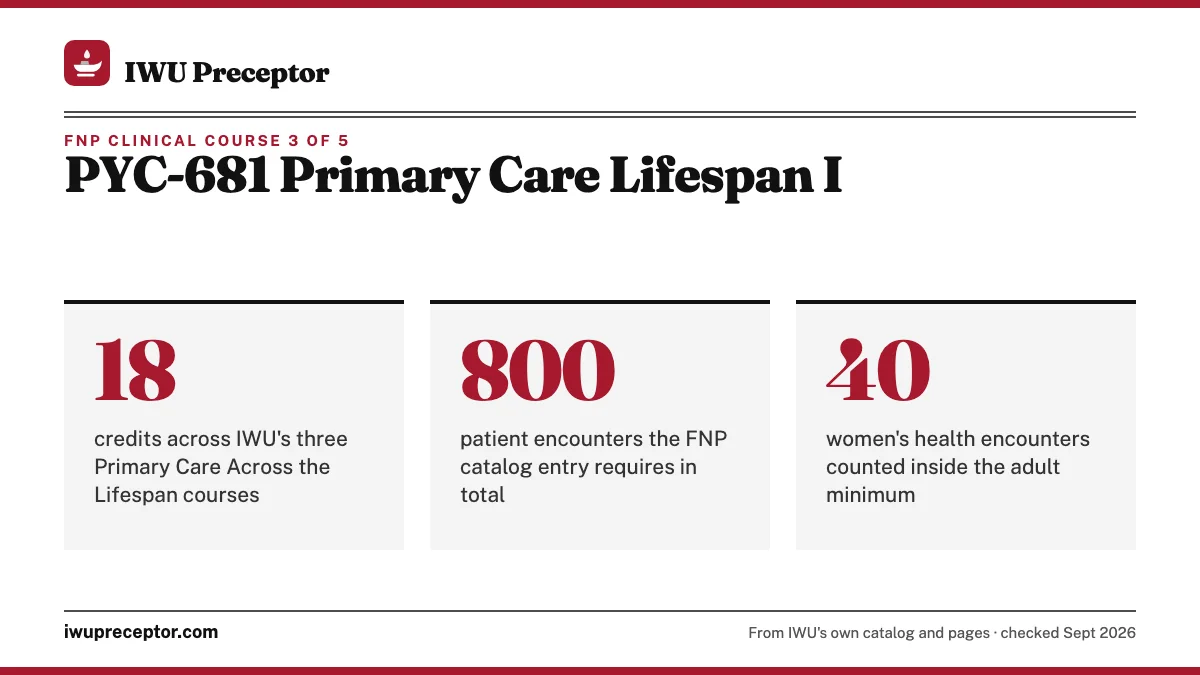
The three lifespan courses, PYC-681, PYC-682 and PYC-683, carry 18 of the 29 credits in IWU's FNP clinical sequence, close to two thirds of the total. PYC-681 opens that block directly after Foundations for Primary Care Practice, and the order is fixed: courses must be taken in the prescribed sequence, one at a time, with the same cohort.
Because the lifespan block is the longest stretch of clinical work, it is where a gap in preceptor coverage costs the most time. A preceptor who can take you for more than one of these courses reduces the number of approvals you need, though IWU publishes no rule on keeping one preceptor across courses, so confirm with faculty first.
The course runs within IWU's modular calendar. National & Global has no semesters; courses typically last 7 to 15 weeks depending on content and clinical requirements, and your section's exact dates show in Self-Service and Brightspace.
Encounter targets to track from PYC-681
The MSN FNP catalog entry pairs its 850 practicum hours with minimum encounter counts. IWU does not divide them by course, so treat them as running totals that the lifespan courses must bring home:
- At least 800 patient encounters across the FNP clinical courses.
- At least 350 adult encounters, of which at least 40 are women's health.
- At least 150 pediatric encounters.
- That leaves 300 of the 800 outside any named group, so visits at any age count toward them.
Tally your log by category at the end of PYC-681. If children or women's health visits are trailing, you still have two courses to rebalance, which is far easier than finding a pediatric site for the final course. Our patient encounters guide sets out each count, and the hour conflict between 850 and IWU's 700-hour web figure is covered on the FNP hours page.
The preceptor and site that suit PYC-681
IWU wants most FNP clinical time in outpatient primary care spanning all ages, whether in family practice, internal medicine, pediatrics or women's health, and it allows some specialty hours. For a course built on acute and chronic disease, the strongest sites are those that keep same-day sick slots alongside scheduled chronic-care follow-ups.
A busy family practice covers both, and all ages. An internal medicine office gives depth in adults with several long-term conditions, which feeds the 350 adult encounters. A pediatric practice suits a student who needs children and wants to manage acute illness and follow-up in younger patients. Urgent care offers acute volume, but IWU keeps most hours in primary care, so ask faculty before relying on it.
Whoever precepts you must meet the qualifications in IWU's NP Clinical Guidelines, which are not published. Faculty visit sites and evaluate both you and the placement in each FNP clinical course, so pick a preceptor who is comfortable with a faculty visit.
Planning around Indiana health systems
If your community is in Indiana, the large systems each set their own student rules. IU Health's Office of Clinical Education accepts advanced practice requests through its online database in fixed windows: December 1 to February 1 for summer, March 1 to April 1 for fall and July 1 to September 1 for spring, with decisions in March, May and October. It discourages direct calls to its providers, and placement through it is not assured.
Franciscan Health offers NP rotations at hospitals in Indianapolis, Mooresville and Carmel and in Franciscan Physician Network, gives employees priority and requires a school affiliation agreement. Deaconess in Evansville says it is not pursuing new affiliations. Whether IWU holds any of these agreements is not public. Independent family practices and community clinics set their own terms, which makes them a practical first stop. The Indiana preceptor page goes further.
Why IWU students choose us for PYC-681
We plan PYC-681 as the start of the lifespan block, not a single course. We look for a primary care preceptor in your community whose panel mixes acute visits and chronic-care follow-ups across ages, and where your faculty allow it, one who can stay with you into PYC-682 and PYC-683.
We handle the paperwork side thoroughly. Your preceptor's license and credentials, the practice's details and every record IWU asks for are gathered and checked, so nothing is missing when the School of Nursing opens your request. IWU makes the approval decision. If a preceptor withdraws partway through, your placement advisor starts a replacement search right away, aimed at the encounter categories you still need. Start with the form below or read how our service works.
Questions IWU students ask
How many clinical hours does IWU's PYC-681 require?
IWU does not publish a course figure. The catalog course page lists 6 credits and says supervised clinical experiences are required; the 2024-25 and 2025-26 PDF catalogs add nothing beyond title and credits. The course target lives in your syllabus. The catalog's program minimum is 850 hours across all FNP clinical courses, while IWU's MSN web page says 700.
Can I use the same preceptor for PYC-681, PYC-682 and PYC-683?
IWU publishes no rule for or against it. Every site and preceptor must be approved, and faculty visit and evaluate the placement in each clinical course. One preceptor across the lifespan block can save approvals, but check that the panel will still deliver your pediatric and women's health counts before committing to one site for all three.
Does PYC-681 need pediatric patients?
The course covers acute and chronic disease across the lifespan, and the program needs at least 150 pediatric encounters before you finish. IWU does not assign those encounters to particular courses, so a site that sees children during PYC-681 keeps the count on pace rather than leaving it to the last two courses.
Can I do PYC-681 clinicals outside Indiana?
Yes, IWU's FNP clinicals are done in your own community. The catalog requires your RN license to be active and unencumbered in each state that hosts one of your practicum sites. According to IWU's 2022 licensure disclosure, the MSN FNP curriculum meets educational requirements in all 50 states, though New Hampshire, New York and Rhode Island add steps of their own.
What happens if I do not pass PYC-681?
PYC courses need a B or better. The catalog says failing a course brings administrative withdrawal from the program, a course may be repeated once, and NP students receive academic dismissal on a second unsatisfactory grade. The Office of Learner Success works with the Program Leader on when a course is retaken.
Related pages
Last checked 2026-09-24
We check these pages against IWU's own catalog and program pages. IWU's NP Clinical Guidelines, your syllabus and your program faculty have the final word.
IWU says you secure the site and preceptor. We make that the easy part.
Tell us your IWU program, your community and when your next practicum course starts. We find preceptors who fit the course and prepare everything IWU vets before it approves them.
- Preceptors matched to the course: primary care across the lifespan for the
PYCcourses, psychiatric care for PMHNP, leaders for HSL - Credentials, license and site details ready for IWU's review and Medatrax
- In your own community, in Indiana or wherever you live and hold your RN license
Start your placement plan
Program, city and start date is all we need to begin.