PYC-670 Foundations for Primary Care Practice: a guide for IWU FNP students
PYC-670 Foundations for Primary Care Practice is the 5-credit clinical that follows Advanced Health Assessment in IWU's FNP sequence. The catalog frames it around family nurse practitioner primary care, with health promotion and diagnostic reasoning at its center, and it requires supervised clinical experiences without naming a course hour figure. A family practice preceptor who sees every age group is the natural fit.
Get your placement plan
Tell us your IWU program and where you live. A placement advisor replies with the preceptor and site options that fit your IWU course.
What PYC-670 covers, in the catalog's terms
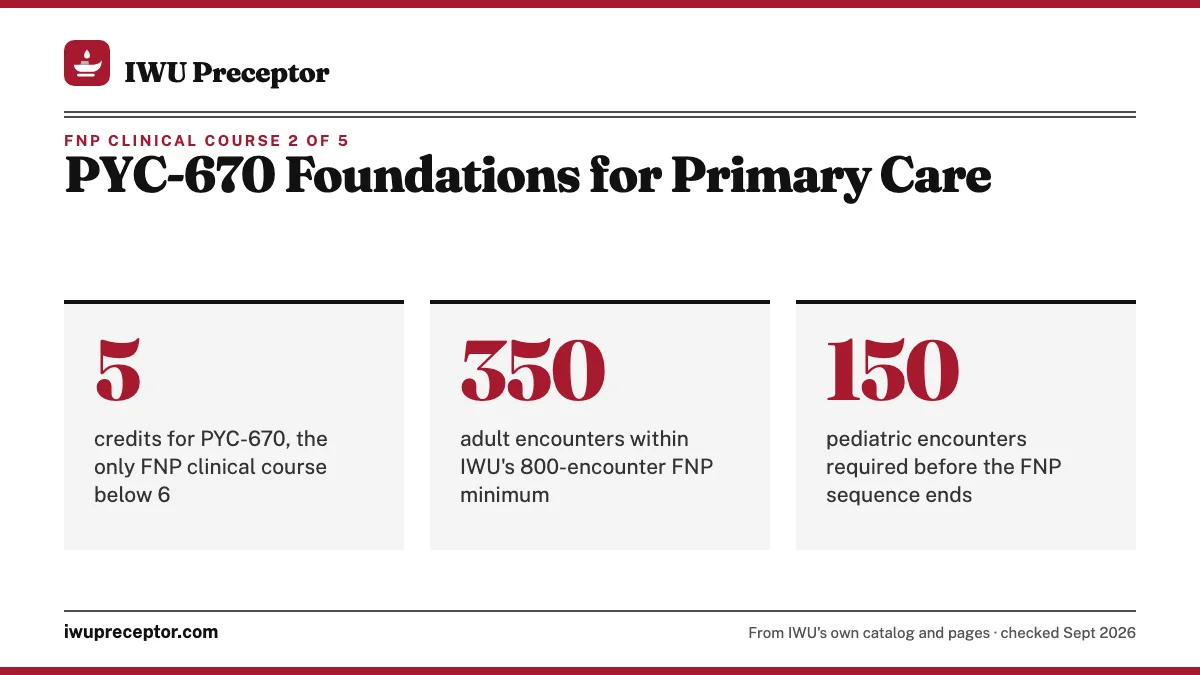
The 2026-27 catalog lists PYC-670 Foundations for Primary Care Practice at 5 credits and describes it as the course that grounds you in family nurse practitioner primary care. Two threads run through the description: health promotion and diagnostic reasoning. The course page adds a single clinical line, that supervised clinical experiences are required.
In clinic terms, health promotion is the preventive side of a primary care day: well visits, risk counseling and the screening conversations that fit a patient's age. Diagnostic reasoning is the other side, taking a presenting complaint through history, exam and targeted testing to a working diagnosis and plan. PYC-660 taught the exam; PYC-670 asks you to use it on the everyday caseload of a family practice.
IWU's BSN-to-DNP FNP carries the same course at the doctoral level as DNP-770 Foundations for Primary Care Practice, also 5 credits with supervised clinical work. For post-graduate FNP certificate students, PYC-670 is the first clinical course inside the certificate itself, because PYC-660 counts as a prerequisite there.
Where PYC-670 falls in the FNP sequence
IWU requires its master's nursing courses in a prescribed order, so PYC-670 always comes second among the clinical courses: after Advanced Health Assessment and before the three lifespan courses. Each course runs one at a time with your cohort, and the certificate FAQ estimates 10 to 15 hours of coursework a week on top of clinical time.
| Course | Credits | Clinical credits done at course end |
|---|---|---|
PYC-660 Advanced Health Assessment | 6 | 6 of 29 |
PYC-670 Foundations for Primary Care Practice | 5 | 11 of 29 |
PYC-681 Primary Care Across the Lifespan I | 6 | 17 of 29 |
PYC-682 Primary Care Across the Lifespan II | 6 | 23 of 29 |
PYC-683 Primary Care Across the Lifespan III | 6 | 29 of 29 |
Finishing PYC-670 puts you past a third of the clinical credits with the heaviest stretch ahead. A B or better keeps you moving; anything lower triggers IWU's progression rules for the major.
Hours and encounters during PYC-670
IWU publishes no clinical-hour figure for PYC-670 on its course page or in its recent PDF catalogs, so the hours you owe in this course are set in the syllabus. The program total is what the catalog does state: at least 850 supervised practicum hours for the MSN FNP, against a 700-hour figure on IWU's MSN web page. Treat 850 as your planning number, and see the clinical hours hub for how IWU's figures compare across programs.
The encounter rule runs beside the hours. Across the FNP clinical courses you need 800 patient encounters or more: a minimum of 350 adult visits, with 40 in women's health among them, plus a minimum of 150 pediatric visits. A family practice fills adult and pediatric columns at once, which is why this course is a smart moment to check how a preceptor's schedule splits by age.
Pediatric volume differs widely from one practice to the next. Before you commit, ask a prospective preceptor roughly how much of a typical week is children, and compare the answer with the encounter targets you still have to meet.
The preceptor and site profile for PYC-670
IWU pictures FNP rotations in lifespan primary care and outpatient practice, and it names four settings: pediatric offices, internal medicine, family practice and women's health. A limited amount of specialty time may be accepted, while primary care takes the majority. For a foundations course, a family practice offers the widest view, with preventive visits and new complaints on the same schedule.
An internal medicine practice suits a student who needs adult volume, and a pediatric practice suits one short on children. Community health centers and rural clinics often run broad family panels as well. What matters most is a preceptor who lets you see patients first, present your findings and propose a plan before stepping in.
Indiana's NP workforce leans toward exactly this setting. The Bowen Center's 2023 renewal data found outpatient clinics were the primary setting for 42.2% of Indiana APRNs, and primary care was the specialty reported most often, at 35.3%. Our Indiana preceptor guide covers where those clinicians practice.
Approval, site visits and health-system rules
IWU's process runs the same way for every FNP course. You identify a preceptor and site, working with program faculty, submit the required documentation, and the university vets and approves both. Faculty then visit sites and run evaluations in each FNP clinical course, looking at your progress and at how well the preceptor and site are working. Our approval guide explains what reaches the School of Nursing.
Large health systems add their own steps. IU Health's Office of Clinical Education takes advanced practice student requests through an online database, one application per semester, and strongly discourages students from calling or walking in on its preceptors. Franciscan Health and Deaconess ask for a school affiliation agreement, and Deaconess says it is not pursuing new affiliations. IWU does not publish which systems it holds agreements with, so ask faculty before you apply.
Why IWU students choose us for PYC-670
We match PYC-670 students with family practice and primary care preceptors whose schedules mix preventive visits, new problems and a healthy share of children, so the course builds your encounter log as it builds your reasoning. Every search runs in your own community, and we can look for a preceptor able to continue into the lifespan courses if your faculty allow it.
Once a preceptor agrees, we collect what IWU vets, from credentials and license details to site information and supporting records, and check each item against IWU's rules before it goes to the School of Nursing. IWU approves every site and preceptor. If a placement falls through before or during the course, a fresh search begins immediately. Share your start date using the form below or read what shapes a quote.
Questions IWU students ask
How many clinical hours are in IWU's PYC-670?
IWU does not publish a course-level figure. The catalog course page says supervised clinical experiences are required and gives 5 credits, and the hour target appears in your syllabus when the course opens in Brightspace. Across all FNP clinical courses, the catalog sets at least 850 hours, while IWU's MSN web page says 700.
Can I complete PYC-670 hours at an urgent care clinic?
IWU publishes no specific limit on urgent care hours. Its FNP guidance says most hours must be in primary care and outpatient settings, with some specialty hours allowed. Urgent care visits tend to be episodic and short on preventive care, which is central to this course, so confirm with course faculty before choosing an urgent care preceptor.
Does IWU find PYC-670 preceptors for students?
IWU's FNP certificate page says students are responsible for securing clinical sites and preceptors. Program faculty work with you, but you identify the preceptor and submit the documentation, and the School of Nursing vets and approves each one. No IWU placement office or site database appears in any public IWU source.
How much time does PYC-670 take each week?
IWU's FNP certificate FAQ estimates about 10 to 15 hours of coursework a week, plus clinical hours on top. Courses usually run 7 to 15 weeks, one at a time, with weekly deadlines and a consistent peer group. Your syllabus shows how the clinical hours spread across the weeks of your section.
Is PYC-670 included in IWU's post-graduate FNP certificate?
Yes. The certificate's 26 credits are PYC-602, PYC-670, PYC-681, PYC-682 and PYC-683, with PYC-614, PYC-612 and PYC-660 as prerequisites. The catalog sets at least 780 practicum hours for the certificate, and IWU's web FAQ says 850, so confirm your total with faculty.
Related pages
Last checked 2026-09-24
We check these pages against IWU's own catalog and program pages. IWU's NP Clinical Guidelines, your syllabus and your program faculty have the final word.
IWU says you secure the site and preceptor. We make that the easy part.
Tell us your IWU program, your community and when your next practicum course starts. We find preceptors who fit the course and prepare everything IWU vets before it approves them.
- Preceptors matched to the course: primary care across the lifespan for the
PYCcourses, psychiatric care for PMHNP, leaders for HSL - Credentials, license and site details ready for IWU's review and Medatrax
- In your own community, in Indiana or wherever you live and hold your RN license
Start your placement plan
Program, city and start date is all we need to begin.