PYC-660 Advanced Health Assessment at IWU: residency, preceptor and hours
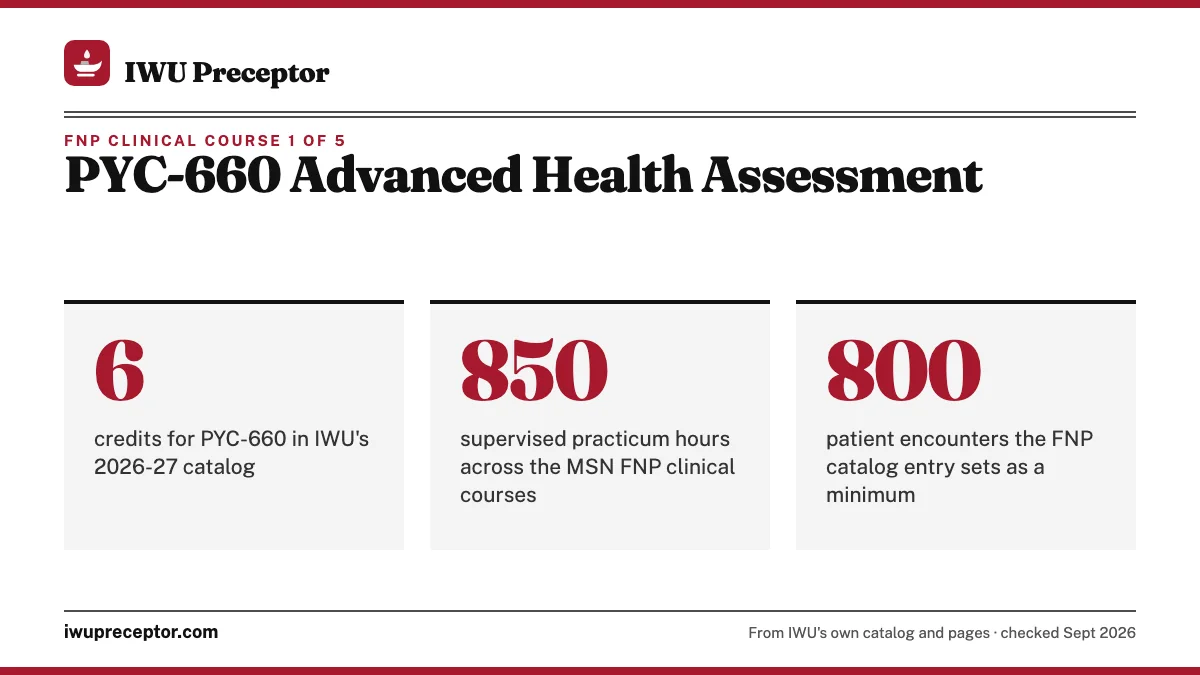
PYC-660 Advanced Health Assessment is the 6-credit course that opens IWU's Family Nurse Practitioner clinical sequence and carries the program's onsite residency in advanced health assessment. The catalog requires supervised clinical experience in it but prints no hour figure for the course, so your syllabus sets the course target while the program rule stays at 850 hours and 800 encounters. Have a preceptor who sees patients of every age confirmed before the course opens.
Get your placement plan
Tell us your IWU program and where you live. A placement advisor replies with the preceptor and site options that fit your IWU course.
What the catalog says PYC-660 covers
IWU's 2026-27 catalog lists PYC-660 Advanced Health Assessment at 6 credits within the Primary Care Nursing master's, FNP specialization. The course description centers on three skills: comprehensive assessment, differential diagnosis and ordering diagnostic tests. It also states that supervised clinical experience is required.
Put plainly, this is where RN assessment becomes provider reasoning. You take a full history, run a systematic exam, build a short list of what could explain the findings and decide which test would narrow it. The public course page stops at that summary. Weekly topics, graded check-offs and the clinical-hour target sit in the syllabus inside Brightspace, which opens to students seven days before a course starts.
The course reaches beyond the MSN. IWU's post-graduate FNP certificate and its post-graduate Nursing Education certificate both list PYC-660 among their prerequisite credits with PYC-614 and PYC-612. Students in the BSN-to-DNP FNP take the doctoral counterpart, DNP-760 Advanced Health Assessment, also at 6 credits.
The onsite residency in Marion
The MSN FNP catalog entry names an onsite residency in advanced health assessment as a program requirement, and the ASN-to-MSN FNP entry repeats it. IWU's FNP certificate FAQ supplies the timing: one residency weekend during the Assessment course, held on the Marion, Indiana campus. The certificate's own catalog entry says its students may need to attend, so certificate students who meet the assessment prerequisite another way should ask faculty whether the weekend still applies.
IWU publishes no agenda, schedule or hour credit for the residency. Your course faculty post the date and expectations for your cohort, and that is the moment to act: book work cover and travel, then tell your community preceptor so your clinic days around the trip stay protected.
Our guide to IWU's onsite residencies compares what every program asks of students in Marion, from the single FNP weekend to the DNP's multi-day visits.
Where PYC-660 sits in the lock-step sequence
IWU runs its master's nursing majors as an accelerated cohort model. Students are registered for every course in the major at the start, take one course at a time with the same peer group, and follow weekly deadlines. The FNP certificate FAQ puts course length at 7 to 15 weeks depending on content and clinical demands.
| Order | Course | Credits | What the catalog emphasizes |
|---|---|---|---|
| 1 | PYC-660 Advanced Health Assessment | 6 | Comprehensive assessment, differential diagnosis, diagnostic tests; onsite residency |
| 2 | PYC-670 Foundations for Primary Care Practice | 5 | Health promotion and diagnostic reasoning in family primary care |
| 3 | PYC-681 Primary Care Across the Lifespan I | 6 | Acute and chronic disease in patients of all ages |
| 4 | PYC-682 Primary Care Across the Lifespan II | 6 | Carries the lifespan sequence forward |
| 5 | PYC-683 Primary Care Across the Lifespan III | 6 | Closes the FNP clinical sequence |
Because the order is fixed, trouble in the first clinical course ripples through the rest. PYC courses need a B or better, and failing a course in the major means administrative withdrawal from the program. Next in line is Foundations for Primary Care Practice.
Hours and encounters: what applies to this course
IWU does not publish an hour figure for PYC-660. Its catalog course page lists title, credits and the supervised clinical requirement, and the 2024-25 and 2025-26 PDF catalogs show only titles and credits. The number of hours you must log in this course therefore comes from your syllabus alone.
At the program level the rule is clear. The MSN FNP catalog entry asks for 850 or more supervised practicum hours and no fewer than 800 patient encounters, among them 350 or more adults (40 of those in women's health) and 150 or more children. IWU's MSN program web page lists 700 clinical hours instead, a conflict our FNP hours page walks through. Plan toward 850 until faculty confirm otherwise.
An assessment course with patients of all ages is a strong place to begin both the adult and pediatric counts, provided your faculty credit encounters from PYC-660. Ask how this course's visits are counted before you log the first one, and see the encounter breakdown for how each minimum is built.
The preceptor and site that fit PYC-660
IWU's certificate FAQ covers the same PYC courses and describes FNP rotations as lifespan primary care in outpatient settings, listing family practice, internal medicine, pediatrics and women's health. A share of specialty hours may be permitted, but primary care carries most of the time.
For an assessment course, a family practice is often the strongest match, because one preceptor may see infants, teenagers, working adults and older patients in a single day. An internal medicine office deepens adult exam skills, and a pediatric office adds well-child and sick-child exams. In any of them, look for a preceptor who hands you the stethoscope, lets you perform the full exam and talks through the differential with you.
The credentials IWU expects a preceptor to hold are not public; they live in IWU's NP Clinical Guidelines. Read the preceptor requirements guide before you ask anyone to sign on.
Clearances due before your first clinical day
Every pre-clinical requirement comes due with PYC-660, since it is the first practicum course. Before any patient contact, IWU's catalog calls for a repeat criminal background check and a drug screen, along with health clearance and immunization records for TB, rubella, MMR, flu and hepatitis B and anything extra the site requires, all paid by you. On a site's request, IWU may share those background, health, immunization and drug-screen records with it.
In IWU's recent catalogs, approvals for your site and preceptor, your health requirements and your compliance education all go into Medatrax, and a student with nothing submitted by week two of a practicum course faces possible dismissal. You also need an active, unencumbered RN license in the state where your site sits. Finish all of it before the course opens rather than during its first fortnight.
Why IWU students choose us for PYC-660
The first clinical course leaves the least room for delay, so our search begins well before your start date. We look in your own community for a primary care preceptor who sees every age group and teaches assessment hands-on, and we check that the clinic calendar works around your Marion residency weekend.
Then we prepare everything IWU reviews, from license verification and credentials to site information and the records IWU requests, so your submission to the School of Nursing arrives whole and in line with its rules at the first attempt. IWU makes the final approval call. Should your preceptor step away partway through, your placement advisor opens a replacement search right away. Share your cohort start date through the form below, or see how it works.
Questions IWU students ask
Where is the IWU FNP health assessment residency held?
IWU's FNP certificate FAQ places it on the Marion, Indiana campus as one residency weekend during the Assessment course. The MSN FNP and ASN-to-MSN FNP catalog entries list the onsite residency as a program requirement. Exact dates and what to bring come from your PYC-660 course faculty once your cohort's schedule is set.
Is PYC-660 the first clinical course in IWU's FNP program?
Yes. It is the first of five FNP clinical courses, followed in the prescribed order by PYC-670, PYC-681, PYC-682 and PYC-683. The role, pathophysiology and pharmacology courses and the GNUR core carry no clinical time, so your preceptor search becomes urgent as PYC-660 approaches.
Do FNP certificate students have to take PYC-660?
The certificate treats it as a prerequisite, along with pharmacology and pathophysiology. IWU's catalog accepts three routes: passing the IWU course with a B or better no more than a year before you start, passing IWU's competency exams, or holding active APRN certification with 500 hours of APRN practice over the previous year. Ask faculty whether the residency still applies to your route.
What happens if I step away from IWU's FNP program after PYC-660?
The catalog says an NP student out of class for more than six months must pass competency exams in advanced pharmacology, pathophysiology and physical assessment and submit a video of a complete history and physical. A student who fails after two attempts audits the course before re-enrolling, at their own expense.
Related pages
Last checked 2026-09-24
We check these pages against IWU's own catalog and program pages. IWU's NP Clinical Guidelines, your syllabus and your program faculty have the final word.
IWU says you secure the site and preceptor. We make that the easy part.
Tell us your IWU program, your community and when your next practicum course starts. We find preceptors who fit the course and prepare everything IWU vets before it approves them.
- Preceptors matched to the course: primary care across the lifespan for the
PYCcourses, psychiatric care for PMHNP, leaders for HSL - Credentials, license and site details ready for IWU's review and Medatrax
- In your own community, in Indiana or wherever you live and hold your RN license
Start your placement plan
Program, city and start date is all we need to begin.