What the best IWU placement service does for you
The best placement service for an Indiana Wesleyan student is built around IWU's own process: preceptors matched to each course code, everything IWU vets ready before you submit, and someone on call if a preceptor steps away. Use the standards below to judge any service, ours included.
Get your placement plan
Tell us your IWU program and where you live. A placement advisor replies with the preceptor and site options that fit your IWU course.
It knows your IWU course, not just your specialty
A generic search for an FNP preceptor misses what IWU asks of each course. PYC-660 Advanced Health Assessment centers on comprehensive assessment and differential diagnosis; PYC-670 builds health promotion and diagnostic reasoning; PYC-681 through PYC-683 work through acute and chronic disease across the lifespan. PMHNP courses shift from assessment in PMHN-652 to individual therapy in PMHN-630 and family and group work in PMHN-640.
The right service asks for your course code first and chooses preceptors whose practice fits it. That is how every one of our searches begins. It is also why leadership and education students get different matches: NRE-664 calls for a master's-prepared preceptor in a clinical nursing practice area, and the HSL practicum courses need a leadership setting.
It plans around IWU's counts and settings
For FNP students, hours are only half the target. IWU's catalog sets 800 patient encounters with adult, women's health and pediatric floors, and its FNP guidance keeps most hours in primary care and outpatient settings across the lifespan. A strong service maps sites to those counts from the start, so you are not hunting for pediatric patients in your last course.
We build that map with you: which course will carry most pediatric encounters, where women's health hours will come from, and when a specialty rotation might fit if your faculty allow it. See patient encounters for IWU's numbers in full.
It hands IWU a complete file
Every site and preceptor passes through IWU's own vetting before approval. The best service respects that and makes the review easy: preceptor credentials, license details and site information gathered, checked against what the course needs, and ready for your submission.
Completeness matters because IWU's recent catalogs tie preceptor and site approvals to Medatrax, along with health requirements and compliance education, and warn that students missing them by the second week of a practicum course may be dismissed. A file sent back for missing pieces costs days you rarely have. Our Medatrax guide explains the three categories, and how IWU approves preceptors covers the review itself.
Approval belongs to IWU alone. A good service earns its place by sending a file that clears on the first review.
It checks licenses and location early
IWU's catalog links clinicals to licensure: wherever a practicum site sits, your RN license must be active there and carry no encumbrance. A service that finds you a preceptor across a state line without checking your license has created a problem rather than solved one.
We confirm where you hold licenses before the search starts, and we look in your own community first, since IWU describes clinicals as happening where the student lives. For students outside Indiana, the state guides cover each board and what changes across borders.
It stays with you after the match
Preceptors change jobs, trim their hours and go on leave. The service worth choosing keeps working after approval: it checks in while your course runs, and it opens a replacement search the day you report a problem.
This is where a service proves its worth. Your placement advisor stays assigned to you across courses, so each new search starts from what we already know about your program, your license and your schedule. Read how it works for the full sequence.
Questions to ask before you commit
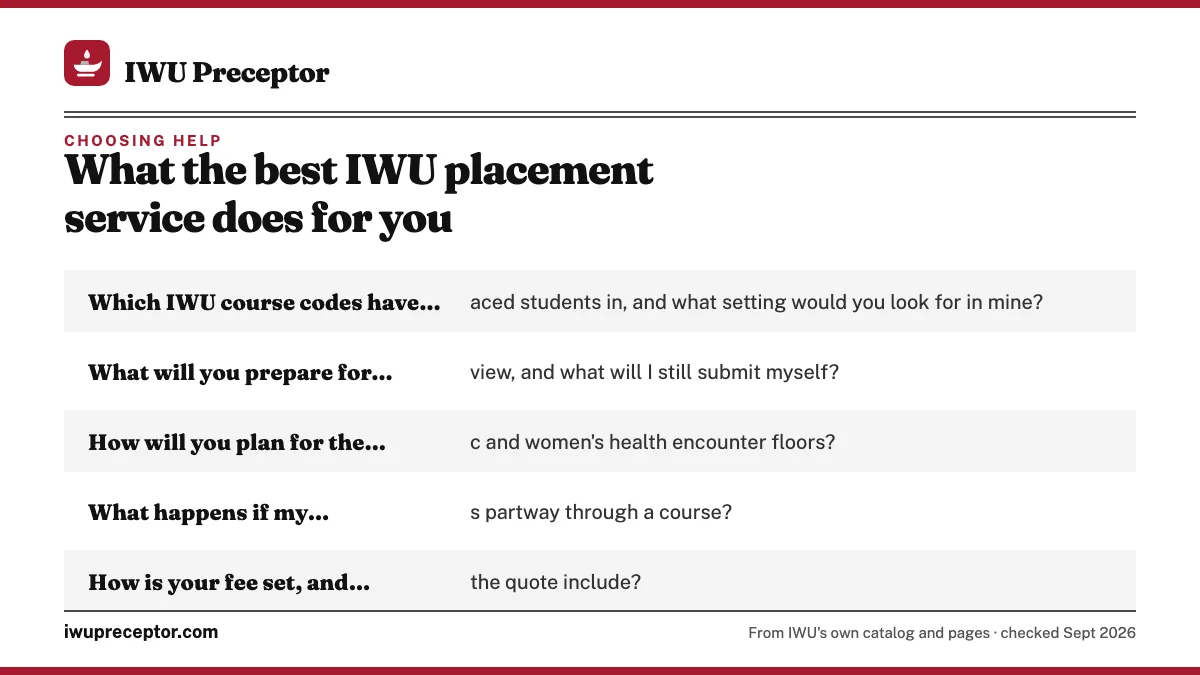
- Which IWU course codes have you placed students in, and what setting would you look for in mine?
- What will you prepare for IWU's review, and what will I still submit myself?
- How will you plan for the pediatric and women's health encounter floors?
- What happens if my preceptor leaves partway through a course?
- How is your fee set, and what does the quote include?
Clear answers to all five are a good sign. For our approach to pricing, see cost; for how a service compares with searching alone, see your options compared.
Questions IWU students ask
Can IWU students use a placement service?
IWU's pages say students secure their own clinical sites and preceptors, working with program faculty, and that the university vets and approves each one. A service helps with the securing, and IWU's review stays exactly the same. Check your NP Clinical Guidelines and syllabus for any course-specific instructions.
Can a placement service speed up IWU's approval?
Only IWU controls its review, and it publishes no approval turnaround. What a service can do is remove the usual causes of delay: missing credentials, an unclear site description, or a setting that does not suit the course. A complete first submission is the quickest route there is.
Should I pick the service that promises the quickest match?
Speed matters, but a fast match that does not fit your course, or sits in a state where you hold no RN license, can cost more time than it saves. Look for a service that asks for your course code, license states and start date before it names a preceptor.
What should a placement service ask me first?
It should start with the basics: which IWU program you are in, which practicum course comes next, where you live, which states have issued your RN license, and when the course opens. For FNP students, it should also ask how your encounter counts are tracking. Those answers shape every preceptor we approach on your behalf.
How much weight should I give reviews?
Reviews help most when they come from students in your own program. Our reviews page gathers feedback from IWU nursing students. Read them alongside the questions above, since a service's grasp of IWU's courses and rules matters more than general praise.
Related pages
Last checked 2026-09-24
We check these pages against IWU's own catalog and program pages. IWU's NP Clinical Guidelines, your syllabus and your program faculty have the final word.
IWU says you secure the site and preceptor. We make that the easy part.
Tell us your IWU program, your community and when your next practicum course starts. We find preceptors who fit the course and prepare everything IWU vets before it approves them.
- Preceptors matched to the course: primary care across the lifespan for the
PYCcourses, psychiatric care for PMHNP, leaders for HSL - Credentials, license and site details ready for IWU's review and Medatrax
- In your own community, in Indiana or wherever you live and hold your RN license
Start your placement plan
Program, city and start date is all we need to begin.